
TL;DR: South Africa’s National Opt-Out Registry records consumers’ instructions to stop the direct marketing covered by their block. Businesses conducting direct marketing must register, renew annually and check their marketing lists to exclude contacts with relevant blocks. Passing that check does not establish permission to call under POPIA, and registration, free preparation and enforcement have different dates.

This guide is for South African consumers who want to understand marketing blocks and business owners preparing marketing campaigns, including Voice AI calls.
I have based this explanation on published documents checked on 6 November 2026. Check the NCC’s current instructions and how the rules apply to your own marketing before running a campaign.
What is a pre-emptive marketing block?
A pre-emptive block is an instruction registered before marketing arrives, telling businesses to exclude you from the marketing it covers. Here, direct marketing means approaching someone to promote goods or services; the Registry records your choice so businesses can check it before contacting you. The Consumer Protection Act’s section 11 establishes the right to register relevant blocks.
In the video, I use this example: “I want no marketing information from Company A”. You do not have to wait for Company A to call before registering that instruction. When Company A checks its planned marketing against the Registry, it must exclude you where your block applies.
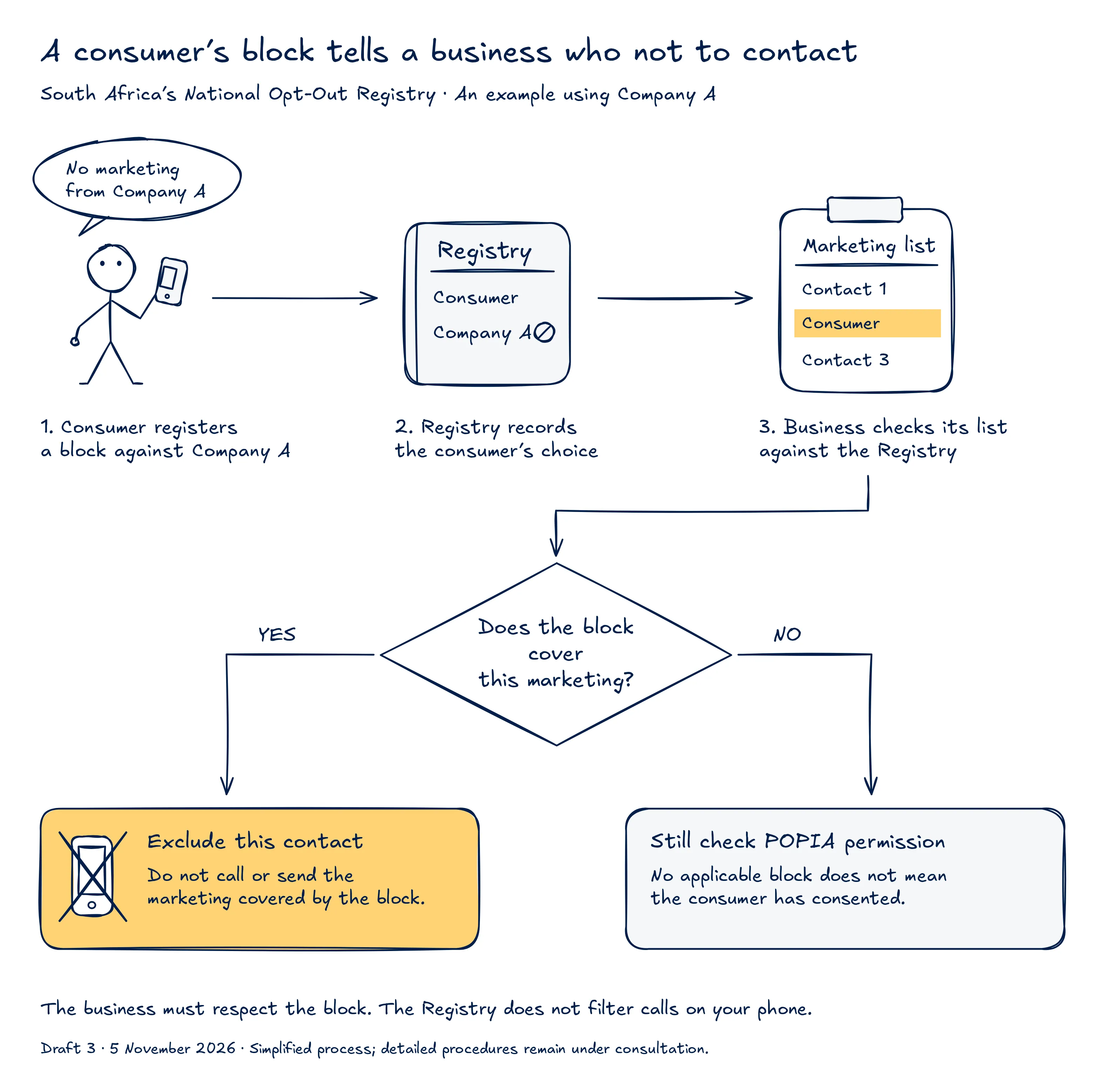
A business must exclude anyone who has blocked its marketing from the list and check whether it has permission to contact everyone else.
The Registry doesn’t stop calls reaching your phone. It records your choice, and the business has to respect it.
Do consumers need to block every business separately?
The system is designed to let you block marketing generally or choose more specific blocks, so you don’t have to name every business individually. The choice you make determines which marketing your block applies to. I haven’t verified which block options are currently available.
The NCC’s October draft guidelines, sections 8–10, describe these choices:
General: You do not want direct marketing generally, within your registered scope.
Sector: You do not want insurance marketing, including from different businesses in that sector.
Company: You do not want marketing from Company A. This does not automatically cover Company B.
Channel: You do not want marketing by email. This does not automatically cover every other channel.
TechCentral’s report of the NCC’s clarification confirms that consumers can already register blocks against registered marketers; it does not verify every general or sector option. The official entry point is the NCC eServices portal.
If you choose only Company A, you may need another instruction for Company B. A general block is intended to avoid that business-by-business process. Businesses must check their marketing lists every month. You don’t have to register the same block again each month.
What must a business check before sending marketing?
A direct marketer must register and renew its registration every year. Before sending marketing, it must check its contact list against the Registry and exclude anyone with a registered block that applies to that marketing. Its marketing list is simply its records of people it plans to contact. The April regulations require monthly cleansing. A single, once-off check is not enough. See amended regulation 4(7).
A list could sit in a spreadsheet, a customer relationship management system, an email platform or a telephone dialler. The business’s marketing list records who it plans to contact. The Registry records the blocks consumers have registered.
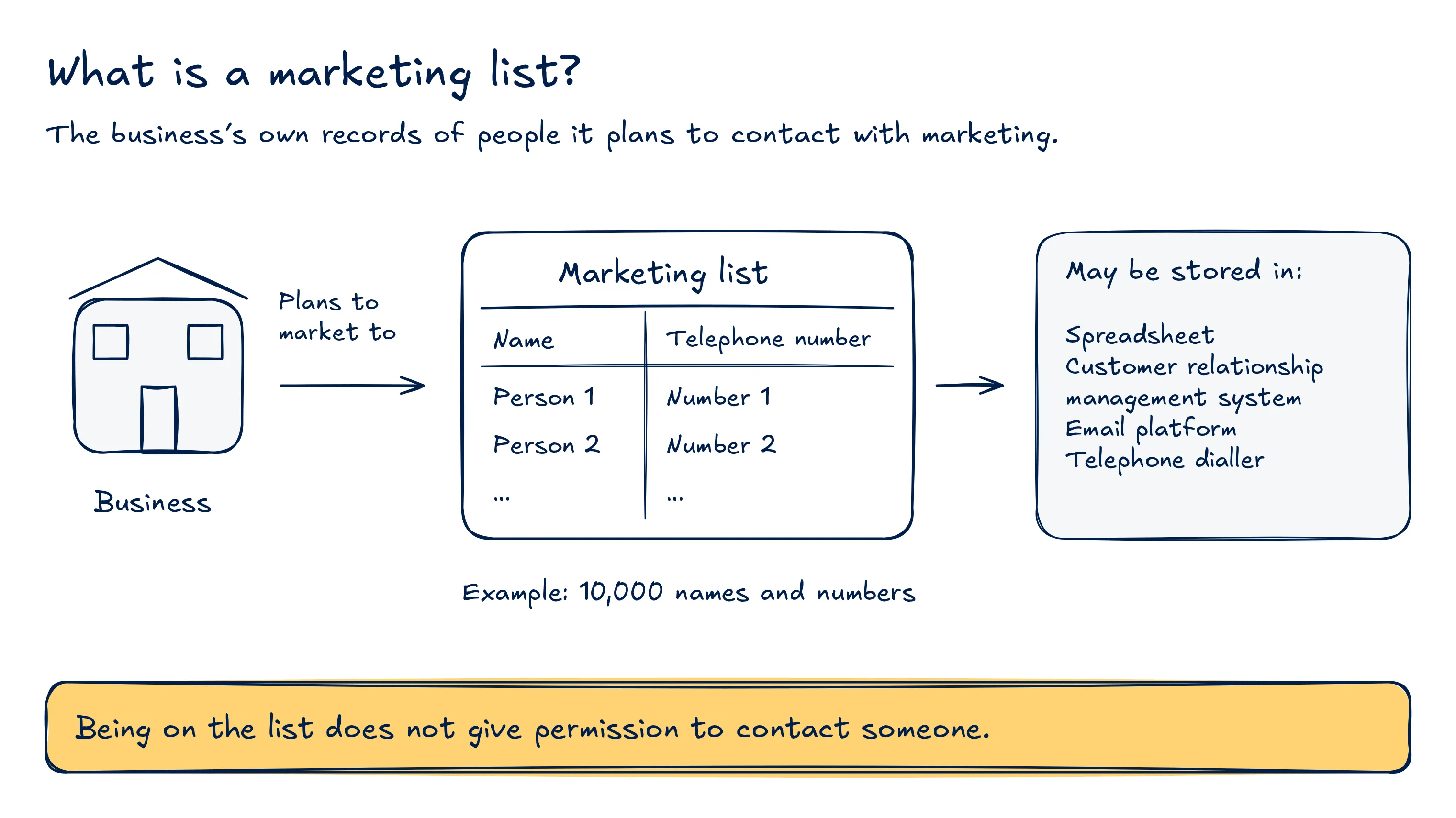
Having someone’s name and number on a marketing list does not mean the business has permission to contact them.
Suppose a business has a list of 10,000 people it wants to call with a sales offer. To cleanse that list, the business checks it against the Registry to identify anyone with a registered block that applies to the planned calls. The business must exclude those contacts from the campaign before it starts calling. Correcting phone numbers or deleting duplicate entries won’t identify those blocks.
The draft guidelines’ section 7 describes the proposed process:
The business submits the contacts it intends to market to through the online system.
The system identifies consumers with applicable registered blocks.
After payment, the business receives results identifying contacts with registered blocks that apply to its planned marketing.
The business excludes those contacts from its marketing list before making calls or sending messages.
Consumers can register new blocks, so businesses must repeat the Registry check every month. A consumer can also ask a business directly to stop sending them marketing. The business must honour that request, whether or not the consumer has registered a block.
When do registration, free preparation and enforcement apply?
As at 6 November 2026, business registration is open, and consumers can already register blocks against registered marketers. Free practice and full enforcement come later.
15 September–December 2026: initial business registration. Direct marketers are expected to register during this period. December marks the end of the initial registration period, rather than registration closing permanently. The NCC warns that failing to register during this period may constitute a contravention afterwards.
9 October 2026: consumer access clarified. TechCentral reported the NCC confirming that consumers could already register blocks against marketers registered on the system. Consumers do not have to wait until May 2027 to register those blocks. I have personally verified that consumer registration is open.
December 2026: free list-cleansing practice starts. Businesses can practise checking their marketing lists against the Registry and prepare their systems. The announced free period ends on 15 April 2027.
15 April 2027: full enforcement and paid cleansing are announced to begin. The NCC says it will enforce list cleansing with a fee from this date.
The registration and preparation dates come from the NCC’s launch announcement. That announcement originally placed the consumer phase in May 2027. The later NCC clarification reported by TechCentral explains the earlier consumer access and the 15 April enforcement date.
A correction to the video: at about 2:56–3:16, I say the registration period has passed and free practice is underway. That was incorrect for 6 November 2026. The initial registration period is still running, and free practice starts in December.
The preparation period gives businesses time to practise. It does not mean a consumer must wait five months after registering a block. Existing POPIA requirements still apply during the rollout.
Who pays to use the Opt-Out Registry?
Consumers can register a marketing block for free.
Businesses pay registration, annual renewal and list-cleansing fees. The amounts change from year to year.
The free practice period covers list cleansing only. Businesses still pay registration and renewal fees.
Consumer registration is free under CPA section 11(5). The business fees in Annexure N of the April regulations are:
| Fee | 2026 | 2027 |
|---|---|---|
| Initial registration | R2,574.00 | R2,702.70 |
| Annual renewal | R1,930.50 | R2,027.03 |
| Cleansing per data entry | R0.12 | R0.14 |
Annexure N lists a cleansing fee “per data entry”. What it does not clearly explain is whether a business pays for its whole submitted list or only contacts with registered blocks that apply to its marketing.
The draft guidelines describe charging only for contacts with applicable registered blocks. TechCentral reports that the NCC confirmed this approach.
Before budgeting, businesses should confirm the current fees with the NCC and ask which contacts they will be charged for.
Does passing a Registry check give permission to call?
No. The Registry check identifies relevant marketing blocks. It does not establish permission to contact everyone else.
For unsolicited electronic direct marketing, POPIA section 69 requires consent or satisfaction of its qualified existing-customer exception.
The Information Regulator expressly confirms that POPIA applies whether or not a consumer has registered a block.
The Information Regulator’s statement of 21 April 2026 makes this clear: someone who has not registered a block has not necessarily agreed to receive marketing.
In the video, I focus on consent. POPIA section 69(3) also allows marketing to existing customers under specific conditions. The business must:
Have obtained the customer’s contact details during a sale.
Be marketing its own similar products or services.
Have given the customer a free, straightforward way to refuse marketing when collecting their details, and provide that opportunity with each marketing communication.
Buying something once does not give a business permission to send any marketing it chooses. The existing-customer exception depends on meeting all these conditions and respecting the customer’s refusal.
The October Registry guidelines cited here are a draft, published for comment. The NCC extended comments until 6 November 2026. That is a deadline for comments, rather than a date when final guidelines automatically take effect.
Before using Voice AI to make a marketing call, the business needs to check two things:
Does it have the person’s consent, or does the marketing meet the existing-customer conditions?
Has the person registered a block that applies to this marketing, or asked the business directly to stop?
The business must establish permission and exclude people with applicable blocks or stop requests before placing the call.
If you are planning Voice AI marketing calls, I can help you work through where permission checks, blocked-contact exclusion and objections belong in your calling process.
FAQ
What should I check if an agency makes marketing calls for my business?
Before the agency makes calls, I would ask how it checks permission, checks the marketing list against the Registry and excludes contacts with applicable registered blocks. I would not rely only on the agency saying it complies with the rules.
The NCC’s draft guidelines, sections 5.2 and 5.4, say that your business remains responsible when an agency markets on your behalf.