
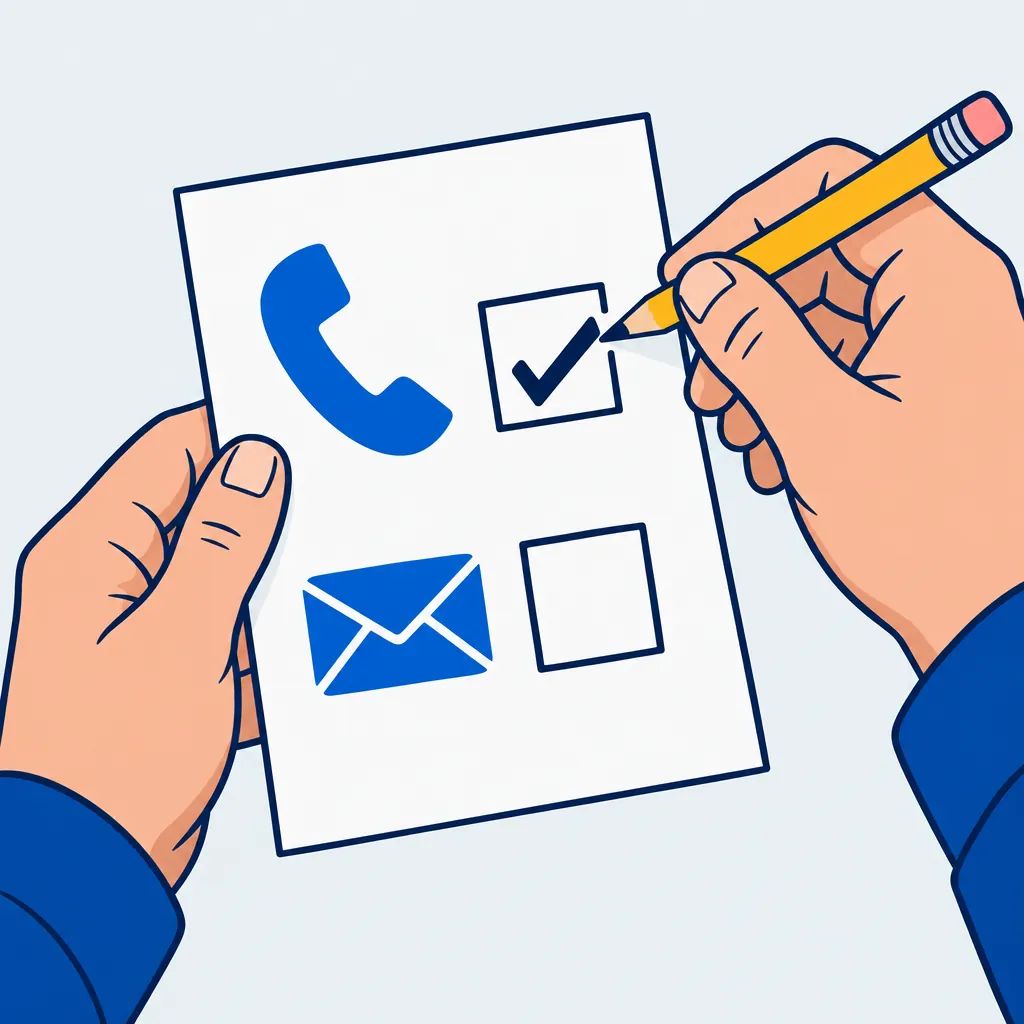
TL;DR: Before your AI agent makes a sales call, check what the person agreed to hear about and whether they chose phone calls. If you want to rely on a past sale instead of fresh consent, check every condition of POPIA’s existing-customer exception. Keep anyone who only asked for a quote off the calling list until you can show what permits the call.

This guide is for South African service-business owners deciding which customers and past enquirers their AI may call with a new offer. It looks at POPIA and Consumer Protection Act rules from the customer’s side, because respecting their choice is how you stay out of trouble and earn trust.
Can you call someone who asked for a quote last year?
No, not on the strength of an old quote alone. If someone asked your business for an alarm quote a year ago and ticked your privacy policy, their number is in your database and they have dealt with you before. Neither of those things gives your AI permission to phone them with a new offer.
Before adding that contact to a campaign, I would check the original enquiry, the wording the person saw on the form and the choices they made. Calling back with the price they asked for answers their enquiry. Calling a year later to sell an incident response service is something else entirely.
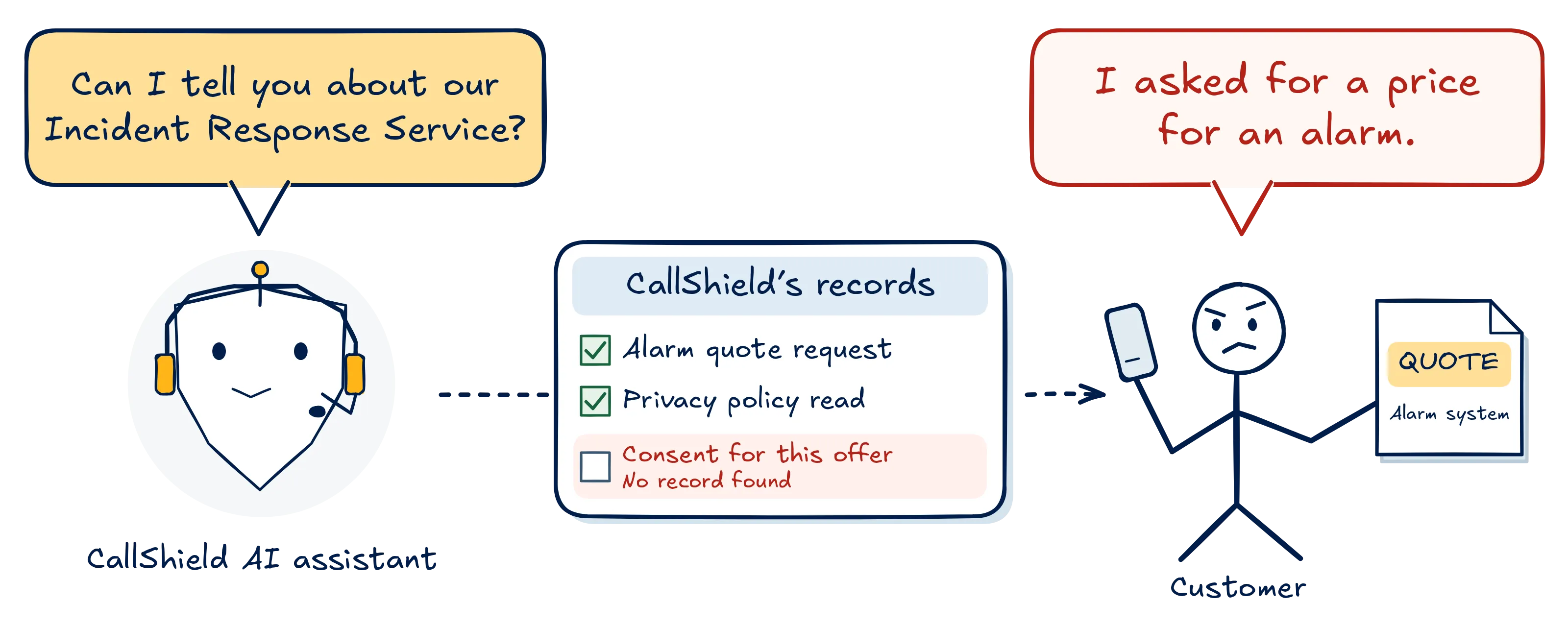
The record explains why the business has the phone number, but those two ticks say nothing about whether the person wants sales calls about incident response.
South Africa’s Protection of Personal Information Act (POPIA) restricts using personal information for unsolicited electronic direct marketing. In plain English, “unsolicited” means the person did not ask you to contact them with that offer. POPIA, section 69 covers automated calling machines and sets out the two routes that allow an unsolicited sales call: valid consent, or a strict existing-customer exception. In its direct marketing guidance, the Information Regulator also treats telephone calls as electronic communication under section 69 (Information Regulator guidance, paragraph 7.1.1).
The same applies if you take a company’s switchboard number from its website. Under South African law, POPIA protects identifiable companies as well as individuals. Publishing an office number tells people how to reach you; it does not invite unsolicited sales calls, even if no opt-out is registered against that number. You still need a lawful basis for marketing under POPIA, sections 1 and 69.
When may you call once to ask for marketing consent?
When you ask, POPIA, section 69(2) gives your business one chance to approach someone, as long as they have not previously refused. From the customer’s side, no means no: if they turn you down on a phone call, you cannot try again by email, SMS or WhatsApp.
One chance means you need to check every channel your team uses to see whether anyone has already asked this person, how they answered and whether they have ever told your business to stop.
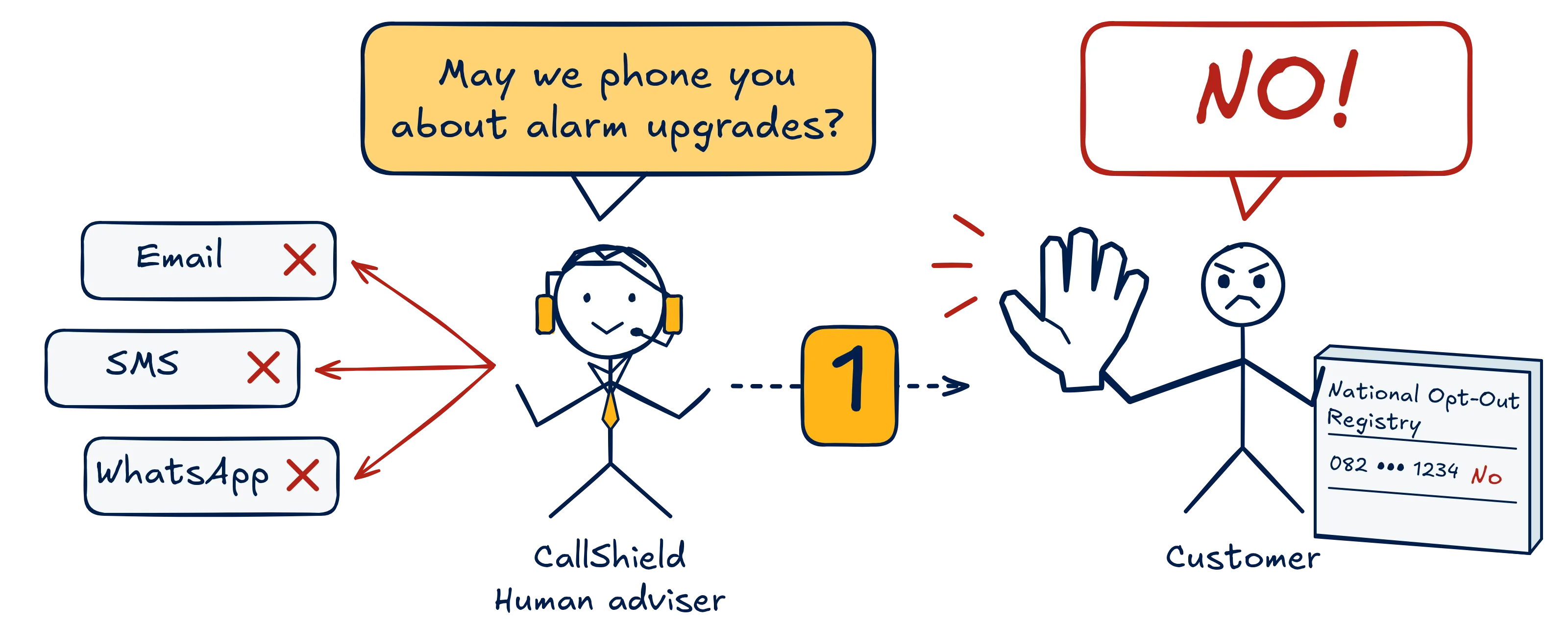
If the customer turns down a phone request, update your email, SMS and WhatsApp lists too so nobody in the business asks them again.
At 2:43 in the video, I spoke about checking South Africa’s National Opt-Out Registry as if you can already search it for a consumer’s block. That was premature. As of 29 November 2026, the National Consumer Commission’s rollout timetable schedules consumer registration and advance blocking for May 2027 (Government rollout announcement). Until that is live, check and honour objections your own business has received. Even once consumer blocking is available, a number not appearing on the Registry only tells you the person has not blocked marketing; it never proves they consented to hear from you (POPIA, section 69).
Suppose CallShield Security, the fictitious alarm installer I use across this series, has checked its records and confirmed it is eligible to ask. Here is how I would have its AI open the call:
“Hello, I’m CallShield Security’s AI assistant. You previously requested an alarm quote from us. I’m calling to ask whether you’d agree to future telephone offers about our alarm upgrades. Is that something you’d like to receive?”
That opening tells the person straight away that they are speaking to AI, names the business, explains why we have their number and asks for a specific choice about future phone calls on alarm upgrades. Under POPIA, section 1, consent has to be voluntary, specific and informed, so the person must understand what they are agreeing to.
South Africa does not have a standalone rule that specifically forces a voice AI to announce itself on a call. Even so, I always disclose it up front. Letting someone think they are speaking to a human risks running into the Consumer Protection Act’s rules against misleading practices, and from the customer’s point of view, being caught out breaks trust straight away. I would also start recording the consent request from the beginning of the call so you capture both the question and the customer’s answer.
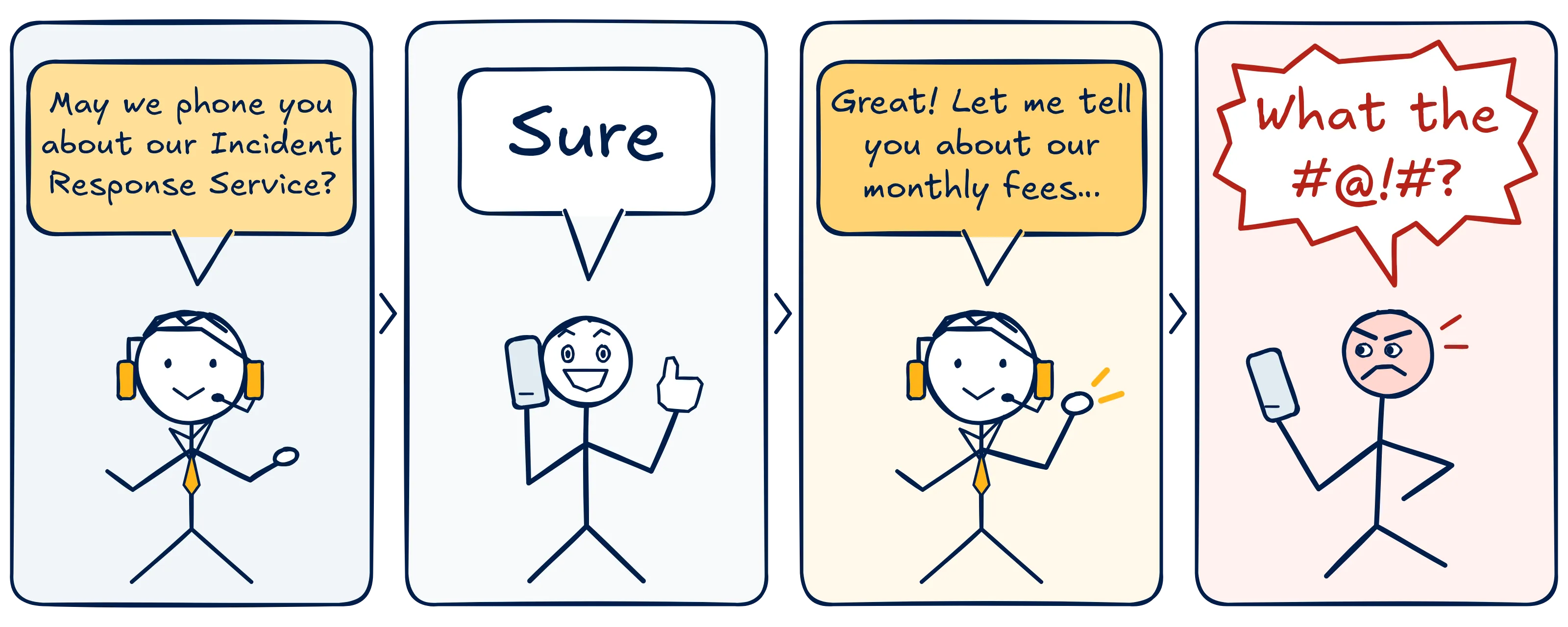
The adviser asks permission to phone about incident response, then immediately starts quoting monthly fees, catching a customer who expected a later call off guard.
Once the customer answers the consent request, I would thank them, record their answer and end the call. Keep the sales pitch for a separate call. Imagine getting a call asking, “Can we phone you about our incident response service?”, saying “Sure”, and immediately getting hit with monthly pricing. Most customers would feel tricked, and rightly so. Ending the consent call cleanly also gives your team a clear point to verify and store the permission before any sales conversation begins.
To be precise on the law: the sources I reviewed do not explicitly settle whether pitching later on the same call is always prohibited once valid consent is given (POPIA, section 69 and direct marketing guidance, paragraphs 7.2.1 to 7.2.7). My recommendation to separate the calls is a practical choice built around the customer’s expectations. If you want to combine consent and sales in one call, have a qualified South African lawyer review your script first.
What should a telephone consent record show?
Typing “yes” next to a name in a spreadsheet is not going to cut it. If someone checks your records six months from now, they should be able to see who asked, which offers were described, which contact channels the customer chose and when they agreed.
POPIA’s amended regulations include Form 4 (PDF pages 21 to 22) as the template for requesting marketing consent. You do not have to post or email that exact PDF for every customer to sign. Your consent process and record still need to capture the substance of both parts of the form.
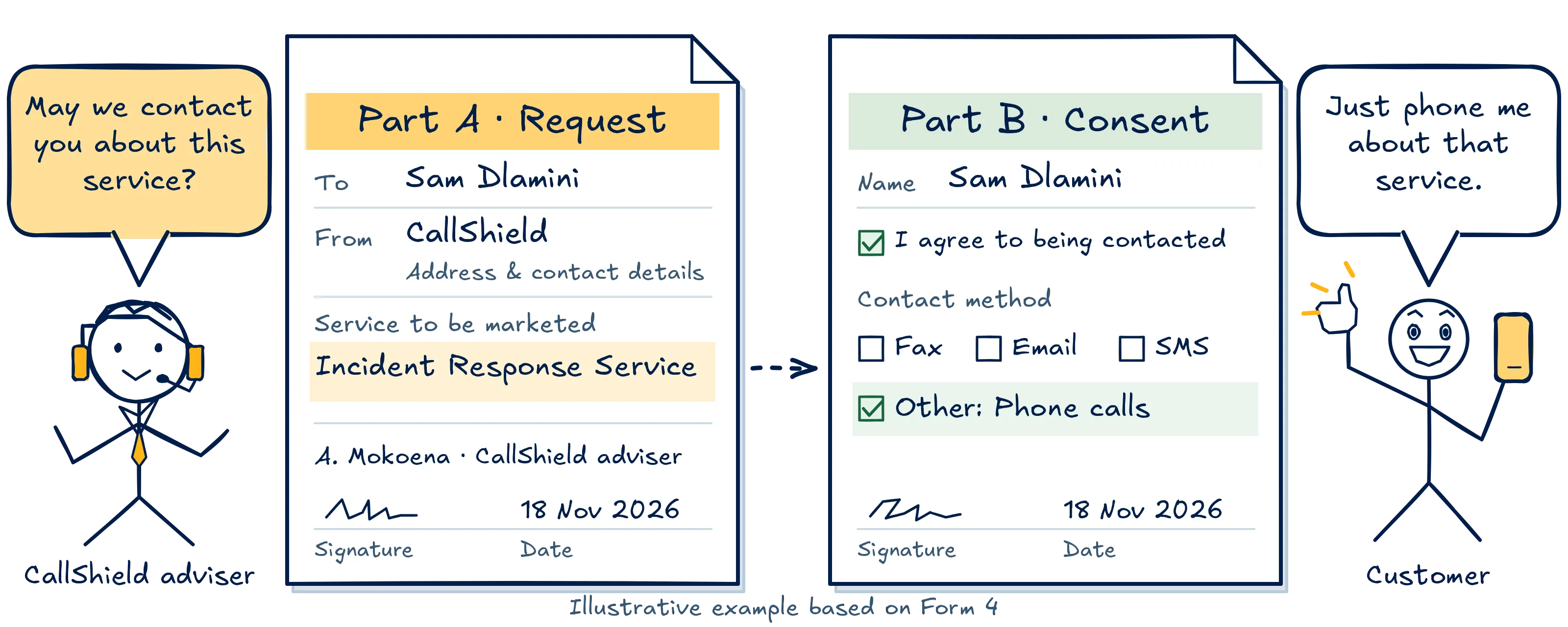
Part A sets out who is asking and what service they want to promote; Part B links the customer’s chosen channel, here phone calls only, to that specific offer.
Set out the request clearly (Part A). Record who you are asking, your business’s name, address and contact details, the exact goods or services you want to market, and the representative and date for the request.
Record the customer’s exact choice (Part B). Capture who agreed, the date and the specific channels they selected. If Sam chooses phone calls for incident response and leaves email unticked, you have permission to phone about that service, not to email or SMS them.
Keep the call recording with the customer record. Under amended Regulation 6, you may use a form substantially similar to Form 4 or another accessible method, including telephone, SMS, WhatsApp or email. Whenever you ask for marketing consent by telephone or automated calling machine, you must electronically record the request and make the recording, or a free transcript, available if the customer asks for it. I would link that recording directly to the date, the exact offer and the channels your sales team is allowed to use.
When can you market to an existing customer?
Under POPIA, section 69(3), you can sometimes market your own similar goods or services to an existing customer without asking for separate consent first. A past sale on its own is not enough, though: you have to satisfy every condition of the exception before your AI dials.
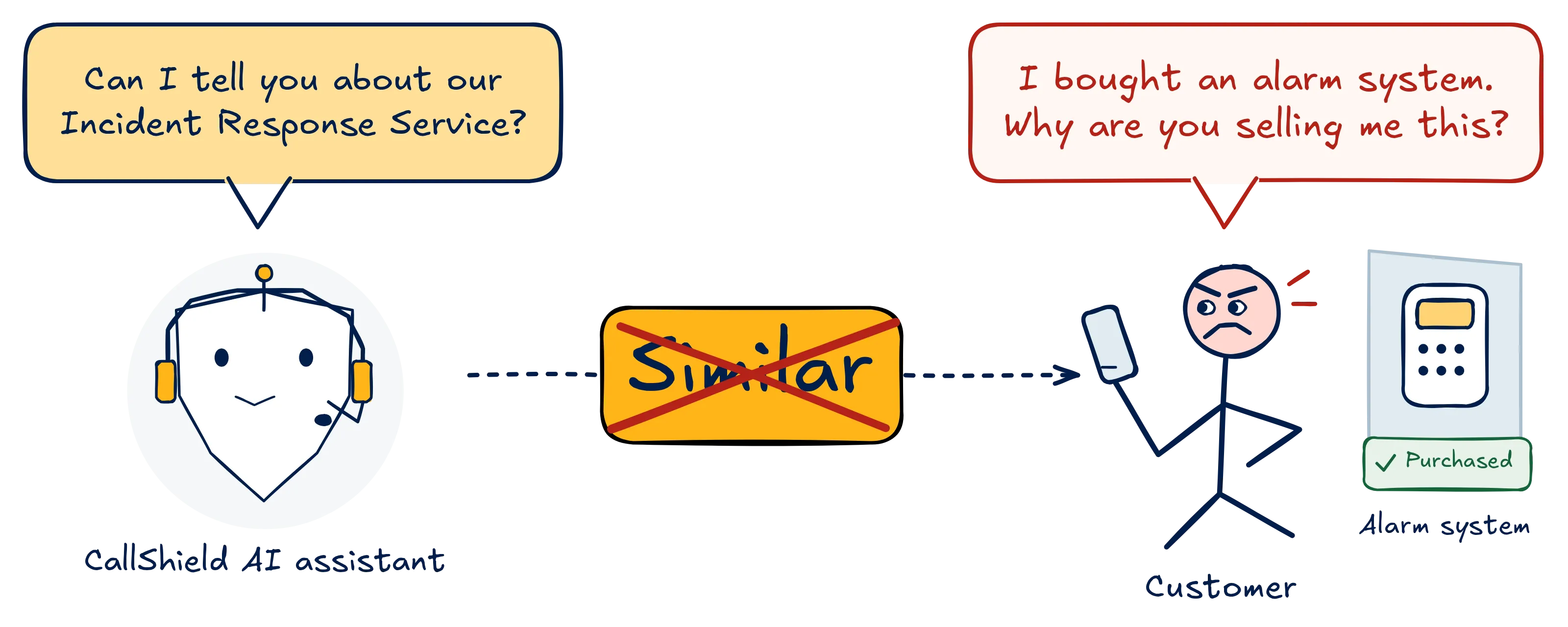
Buying an alarm system does not make a separate incident response subscription a similar product under the existing-customer exception.
Before relying on this exception, check all three conditions against the customer’s order:
How you got the number. You collected the customer’s contact details in the context of a sale to them, not from a general enquiry or a bought list.
What you are offering. You are promoting your own similar goods or services. Apples and oranges are both fruit, but they are not the same thing. Selling someone an alarm system is a much closer fit with an alarm upgrade than with a separate incident response subscription. Check the terms of the original sale, and if the link feels stretched, get legal advice or ask for explicit opt-in consent instead.
The chance to say no. When you collected their details at the sale, the customer had a reasonable, free and easy way to decline marketing. If they did not decline, every later marketing call or message must still identify your business and give them a straightforward, free way to stop future offers (POPIA, sections 69(3) and 69(4)).
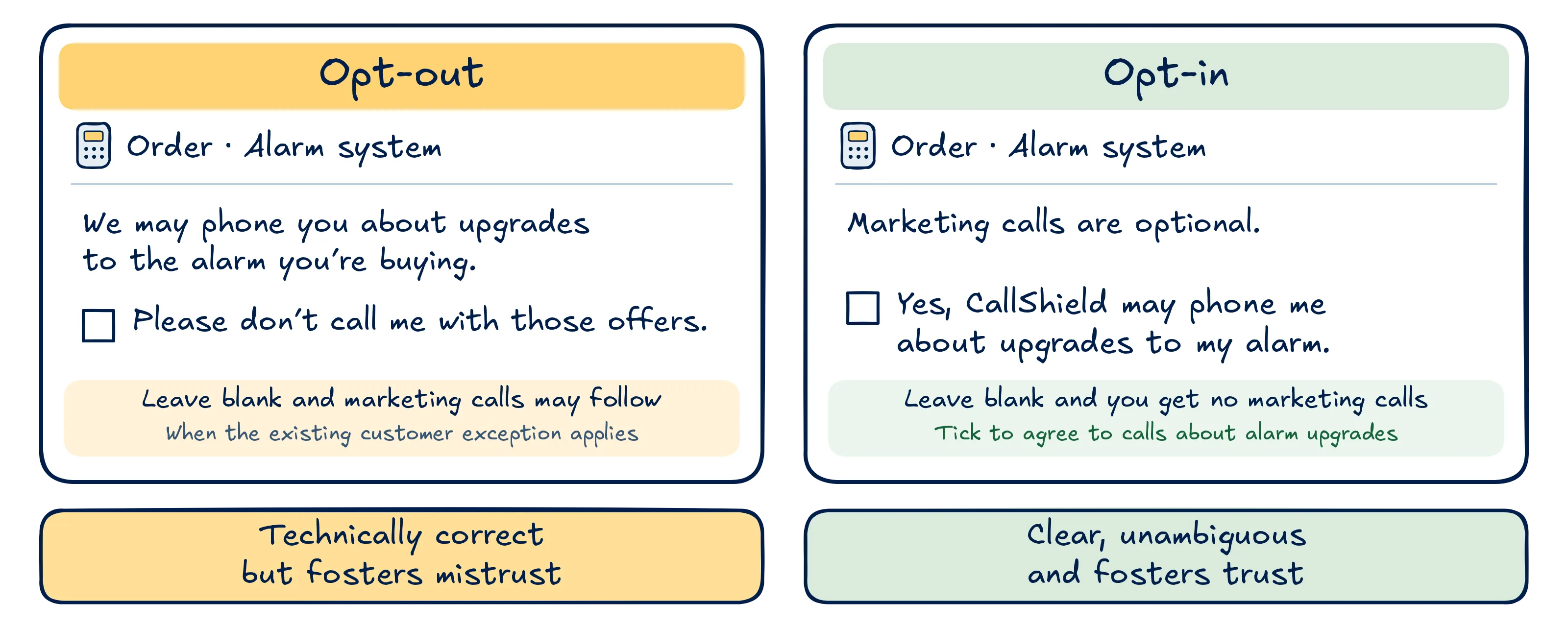
On the left, leaving the opt-out box blank can still lead to upgrade calls where the exception applies; on the right, the customer only gets calls if they actively tick yes.
One detail genuinely surprised me when I researched this video. Most customers assume opt-out marketing is illegal, and where you need consent under section 69(2), an unticked opt-out box cannot give you consent (amended Regulation 6.4). Under South Africa’s existing-customer exception, however, giving a buyer an opt-out box on the order form is technically legal if all the other conditions are met.
Even so, relying on an opt-out opens a can of worms. Six months later, when a customer asks why you are phoning them, explaining that you are technically allowed to call because they failed to tick a box only creates bad feeling. Keep it clean: put an unticked opt-in box on your order form so the customer actively chooses whether they want upgrade calls. If they leave it blank, you do not call. If they tick it, there is no argument six months down the line.
What if a customer asks for a 9 p.m. marketing call?
For direct marketing aimed at a consumer at home, get their express written agreement before scheduling a 9 p.m. call. At 11:07 in the video, I suggested simply logging the customer’s spoken request, which misses the written-agreement rule for deliberately timing a marketing contact during prohibited hours (Timing notice under the Consumer Protection Act, paragraphs 1 to 2).
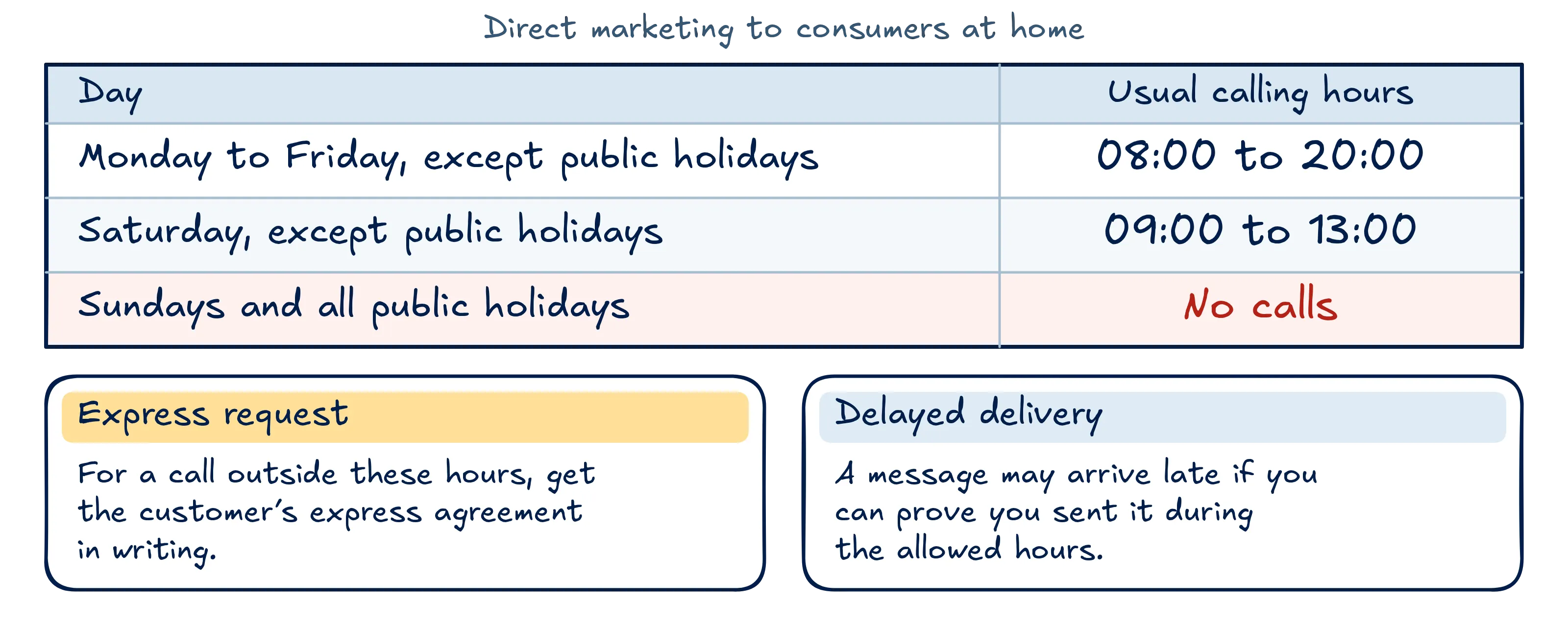
Even within weekday or Saturday morning hours, you cannot call if the day is a public holiday.
Nobody wants a sales call on a Sunday or at ten o’clock at night. Under the Consumer Protection Act timing notice, direct marketing to consumers at home is restricted to 08:00 to 20:00 on weekdays and 09:00 to 13:00 on Saturdays, excluding public holidays. Sundays and public holidays are off limits completely.
While paragraph 1 of the notice recognises that a consumer can request or agree to a different time, paragraph 2 specifically requires express written agreement if you deliberately schedule marketing for a prohibited period (Timing notice, paragraphs 1 to 2). Suppose you reach a customer at 4 p.m. and they say, “I can’t talk now, phone me at nine tonight.” I would have the agent answer like this:
“Certainly. Could you please confirm that request in writing, perhaps by SMS or email?”
Store that written confirmation alongside the scheduled callback. Bear in mind that agreeing to a 9 p.m. slot only covers the time of the call; your business still needs valid permission for the marketing offer itself.
If you send a marketing SMS at 19:55 on an ordinary weekday and the customer’s phone is switched off until 21:00, the timing notice looks at when you sent it, not when it arrived. Keep your dispatch log, because under paragraph 3 of the timing notice, the marketer has to prove the message went out within the allowed hours.
What should happen after an unanswered consent call?
Log that the phone rang and nobody answered, and treat silence as no answer to your consent question. I have not found a rule in POPIA, section 69(2) that settles whether an unanswered ring uses up your single approach, so check the contact’s full history and any objections before trying again.
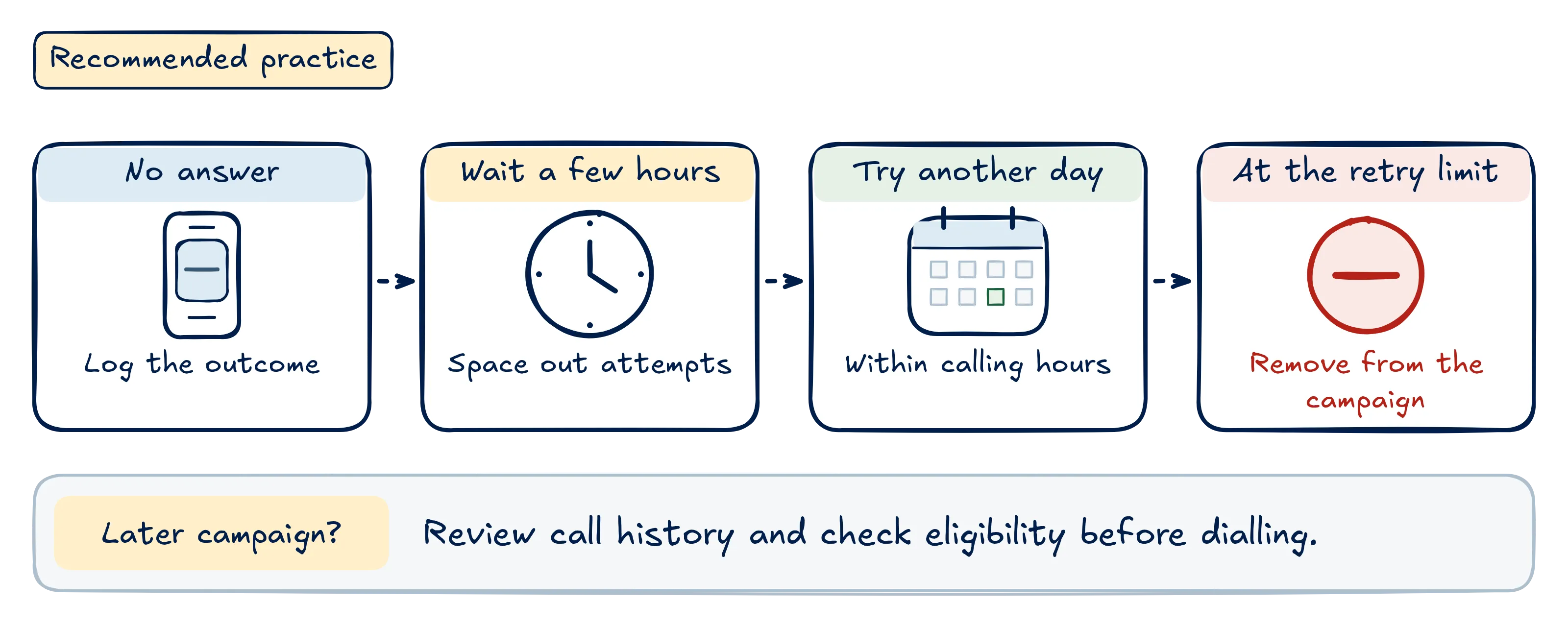
Decide your retry limit before the campaign starts so the dialler knows when to stop calling and remove the number from the list.
If your calling process allows retries after no answer, use common sense and look at it from the customer’s side. Do not redial every few minutes. Wait a few hours, try on another day within the allowed calling hours and log every attempt. I will not give you a universal retry number because the law does not set one, so agree on a modest cap before launch and pull the number from the campaign once you reach it. If that person comes up again in a campaign six months later, check their full history and eligibility from scratch; a new campaign does not give you fresh permission.
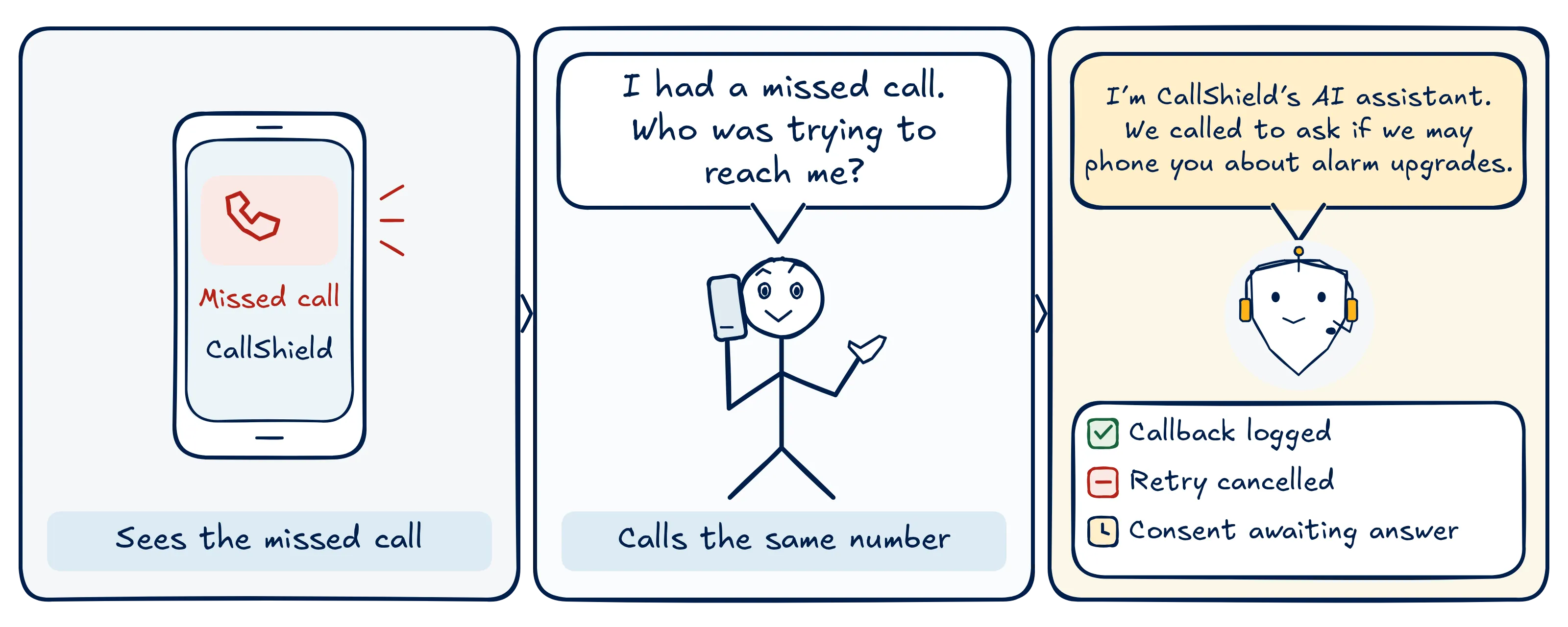
Answering a returned missed call lets you explain who tried to reach the customer, cancel the queued retry and leave marketing consent open until they actually decide.
Think too about what happens when someone sees a missed call on their phone and dials the number back to find out who tried to reach them. Have a person, or an inbound AI assistant that identifies itself straight away, answer that number. Explain who called and why. If they only phoned back to find out who rang, answer that question and let them decide whether they want to hear from you, rather than treating the callback as an invitation to pitch.
What should the agent do when someone says “not interested”?
It depends on what the agent asked. “Not interested” means a refusal of marketing permission when the agent asked for consent, but it may only decline one offer when the customer had already consented to calls. If the meaning is unclear, pause follow-up and have a person review the call.
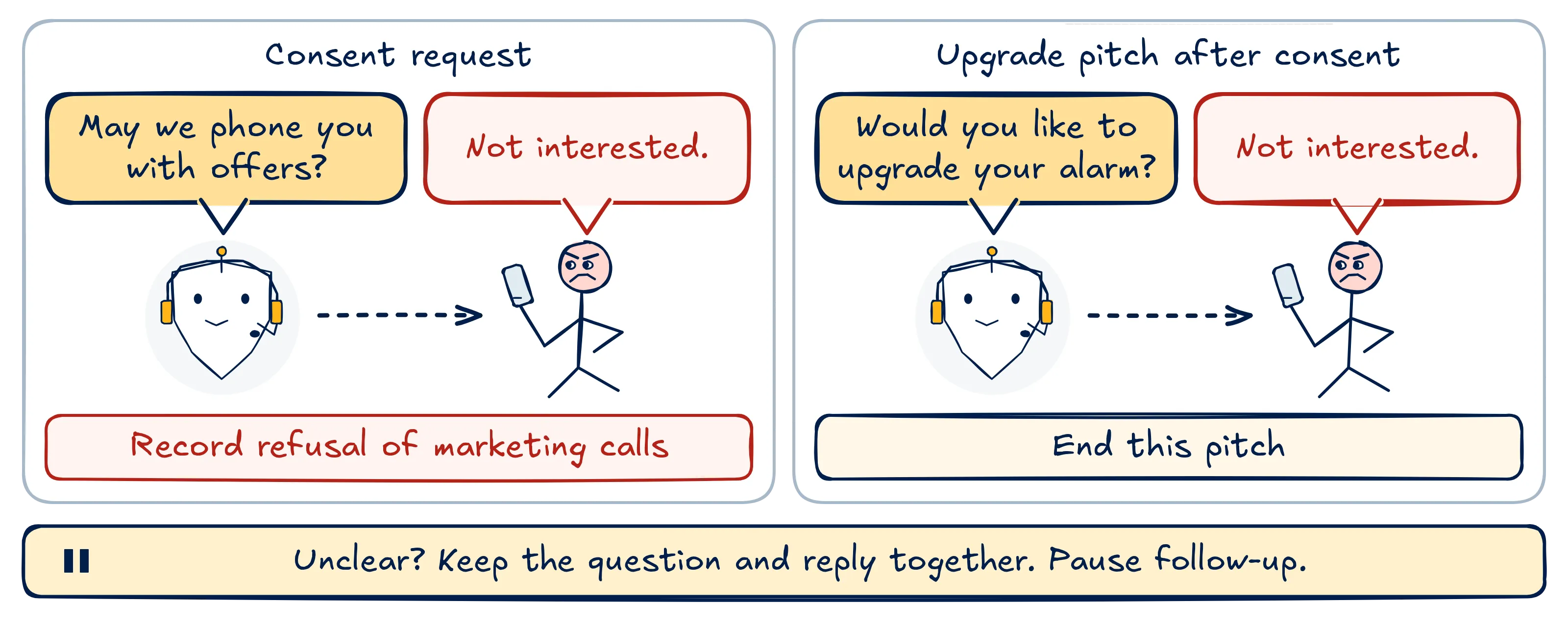
Check which question the customer was answering: saying “Not interested” to a consent request stops future contact, while saying it to an upgrade pitch only ends that offer.
Keeping the question and answer together stops your system making the wrong call. If the agent asked whether CallShield may phone with offers and the person said “Not interested”, record that consent was refused and stop. If the person had already agreed to marketing calls and said “Not interested” to an alarm upgrade, end that pitch politely; their broader consent may still stand unless they ask you to stop.
When someone goes further and says, “Stop using my number for marketing”, treat it as a full marketing objection. Under amended Regulation 2.5, when a customer objects by telephone to how you use their personal information, you must electronically record that objection and make the recording or a transcript available on request. Take the number off your marketing list immediately and cancel any calls or messages already sitting in the queue.
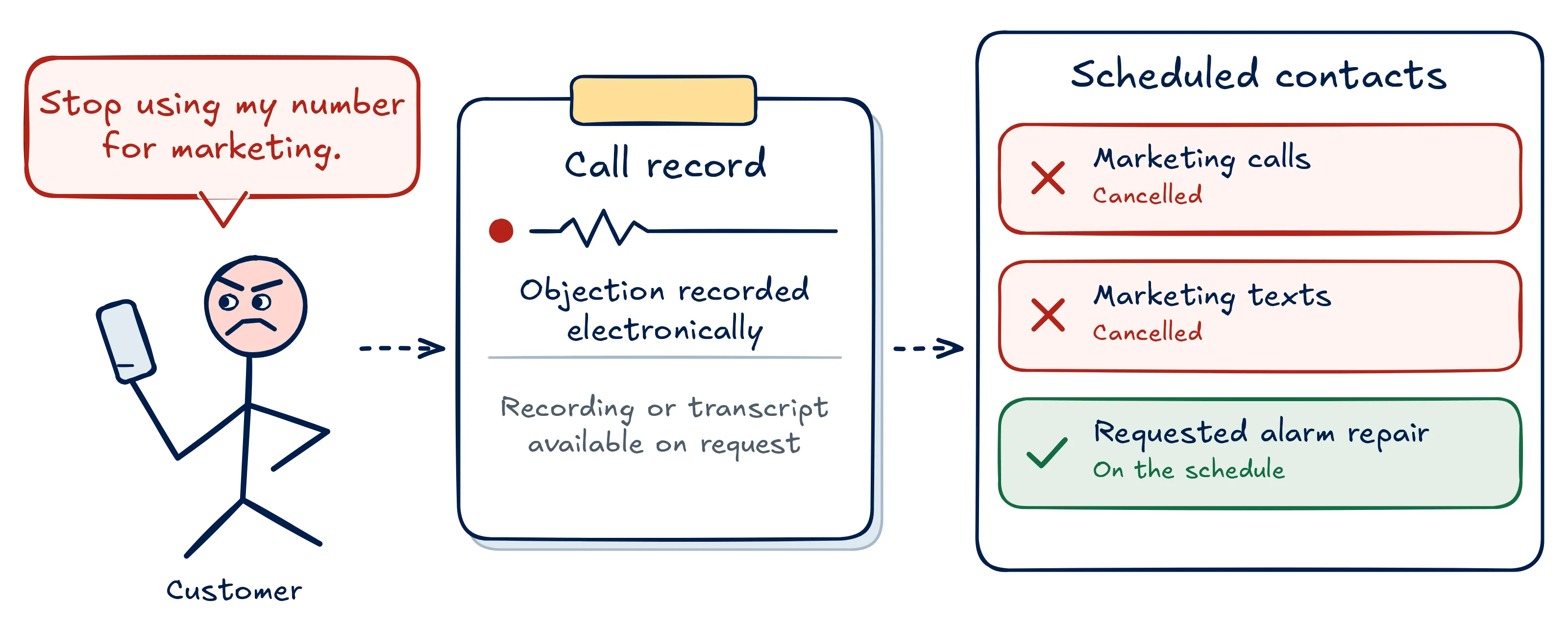
Once you record the objection, remove any queued sales calls and texts, and leave the customer’s booked repair in place.
Notice in the illustration that the customer’s booked alarm repair stays on the schedule. A marketing opt-out stops promotional contact, not the service work the customer requested; just make sure any call about that repair sticks strictly to the repair.
Stick to what the customer asked for when they switch channels during a call:
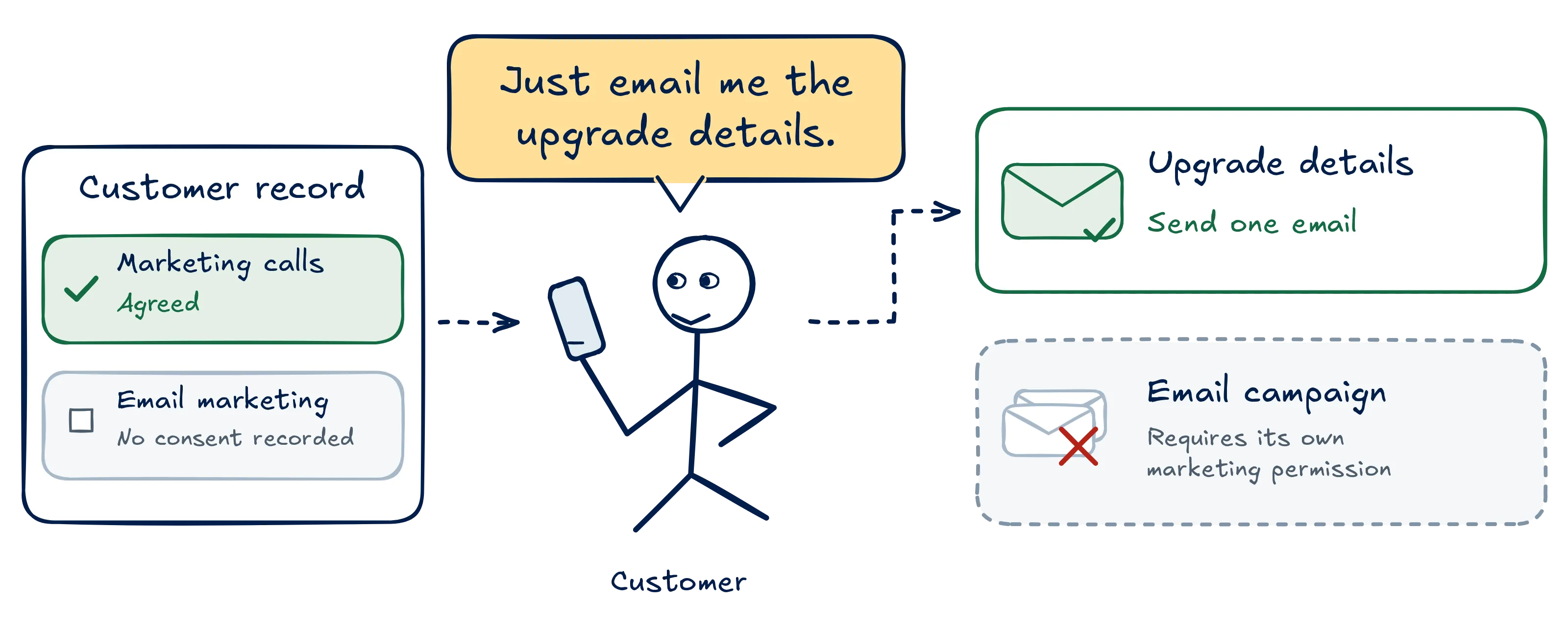
Asking you to email the upgrade details authorises that single email, not adding the customer to ongoing email campaigns.
Suppose a customer who agreed to phone calls says, “I can’t talk now, just email me the upgrade details.” Record that request and send the email they asked for. Do not take it as permission to add them to your monthly email newsletter or future email promotions; your record so far covers phone offers and that one requested email (POPIA, sections 1 and 69).
FAQ
What if someone who opted out calls to ask about an upgrade?
Answer their question and arrange whatever follow-up they ask for, while leaving their marketing opt-out in place. Log that specific enquiry separately. If they ask for a price tomorrow, your adviser can send the quote they requested without putting them back onto next month’s marketing list.
What should you check before your next campaign?
Pick one offer and one contact on your calling list today. Ask the person running your campaign to show you, from your records, why your business may make this offer, by phone, to this person. If they have to guess, hold the call. Respecting the customer’s choice is how you keep your business out of trouble and earn their trust.
I am not a lawyer, and this article is general information rather than legal advice. Have your legal team or a qualified South African lawyer review your calling process before running outbound campaigns.
If you are planning an outbound AI campaign and want help turning these checks into the rules your calling system enforces before it dials, I can help you map out that workflow.