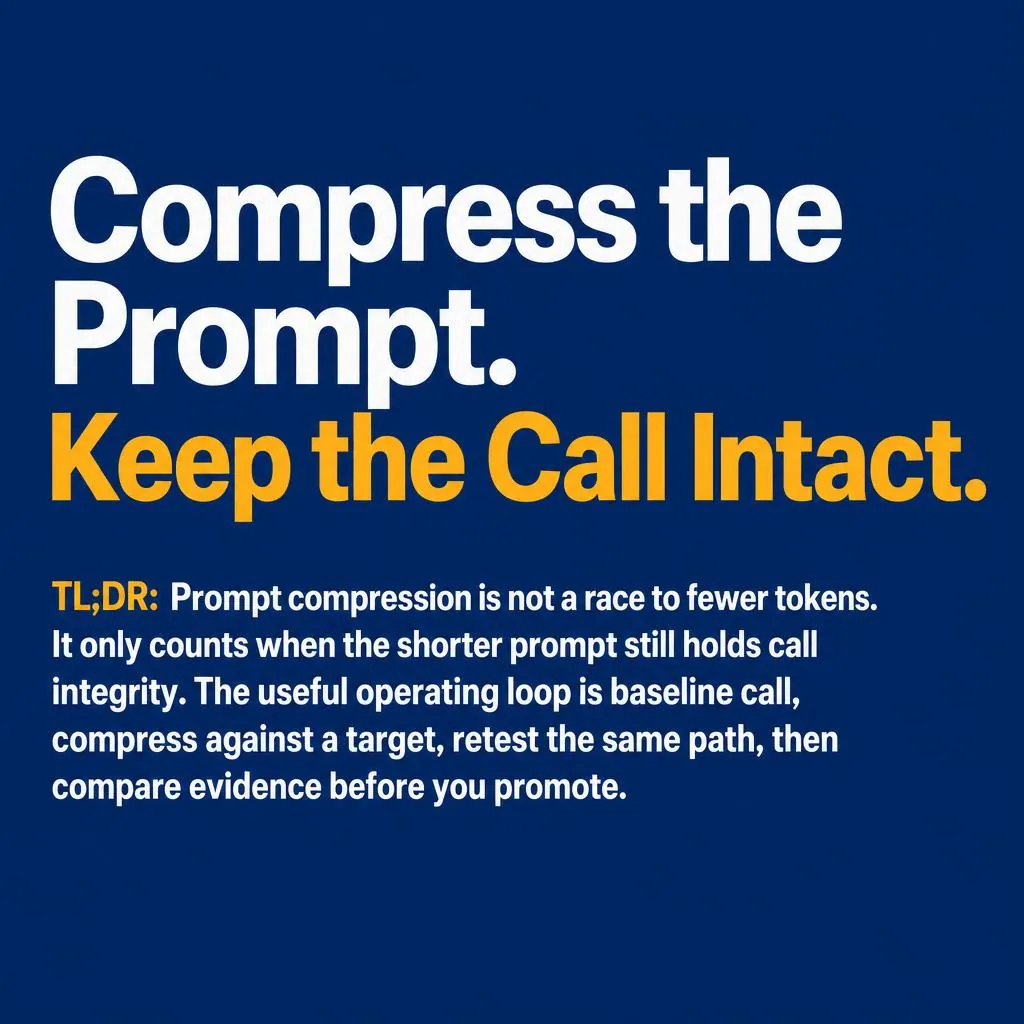
TL;DR: Prompt compression is not a race to fewer tokens. It only counts when the shorter prompt still holds call integrity. The useful operating loop is baseline call, compress against a target, retest the same path, then compare evidence before you promote.
A shorter voice agent prompt is not automatically a better prompt.
That sounds obvious after a bad call. It is less obvious when you are staring at a long system prompt and looking for savings.
In our local-only VAPI voice management system, we now run prompt compress as a controlled process. The goal is simple and strict: reduce prompt size as far as we can without losing the call structure that keeps the conversation together.
We tested it on Miles.
Miles is the production agent. Miles Jr. is the testing environment. The important discipline was not clever rewriting. It was keeping the test path stable.
First we ran a happy-path web call against the original prompt: greeting, what we do, CRM integration, pricing, then message taking with name and callback number. That call became the baseline. It also showed a real problem: significant latency, especially around the tool call.
Then we captured the call ID and pulled evidence from VAPI and Langfuse. That gave us a snapshot of what the call actually did before any pruning.
Only after that baseline did we run the compression skill.
The skill set an outcome target, in this case about a 10 percent reduction. It produced a detailed report of what it wanted to cut and why. The first pass overshot the token budget. The skill revised. After approval, it wrote backups and files locally, proposed evals and simulations, and landed inside the target: 414 tokens removed, roughly 10 percent, with prompt formatting still passing.
That is the difference between compression as guessing and compression as operations.
We then promoted the compressed prompt to Miles Jr. and ran the same happy path again.
The post-compress call still completed the path. It sounded cleaner than the baseline. Latency came down. The comparison report then put the change into numbers the business can inspect: measured tokens, call duration, cost, latency, and behaviour notes. Some issues remained, especially around knowledge retrieval and tool-call timing. Those still need work. But the point of this pass was not to solve every problem at once. It was to prove we could prune while holding call integrity.
For a business owner, this is the practical distinction.
Anybody can ask an LLM to make a prompt shorter. That is easy. The harder question is whether the shorter prompt still protects greeting quality, message capture, callback handling, and the rest of the call structure that customers experience as competence.
Token savings help. They can reduce cost and improve responsiveness. But if pruning removes the wording that keeps the call on track, the savings are false economy.
The operating principle is narrow and reusable: prune against a target, retest the same path, and only keep the cut when the evidence says the call still holds.
Stop guessing which prompt lines are safe to remove. Book a free 30-minute discovery call and we will review your live voice agent with you: https://patrickmichael.co.za