
TL;DR: If an AI receptionist interrupts callers, the problem is not just awkward timing. It can make customers feel rushed, unheard, and less confident in the business. The right response is to diagnose the specific call behavior and tune turn-taking carefully, not rewrite the whole assistant.
A phone assistant can say the right words and still leave a poor impression.
One of the fastest ways this happens is interruption.
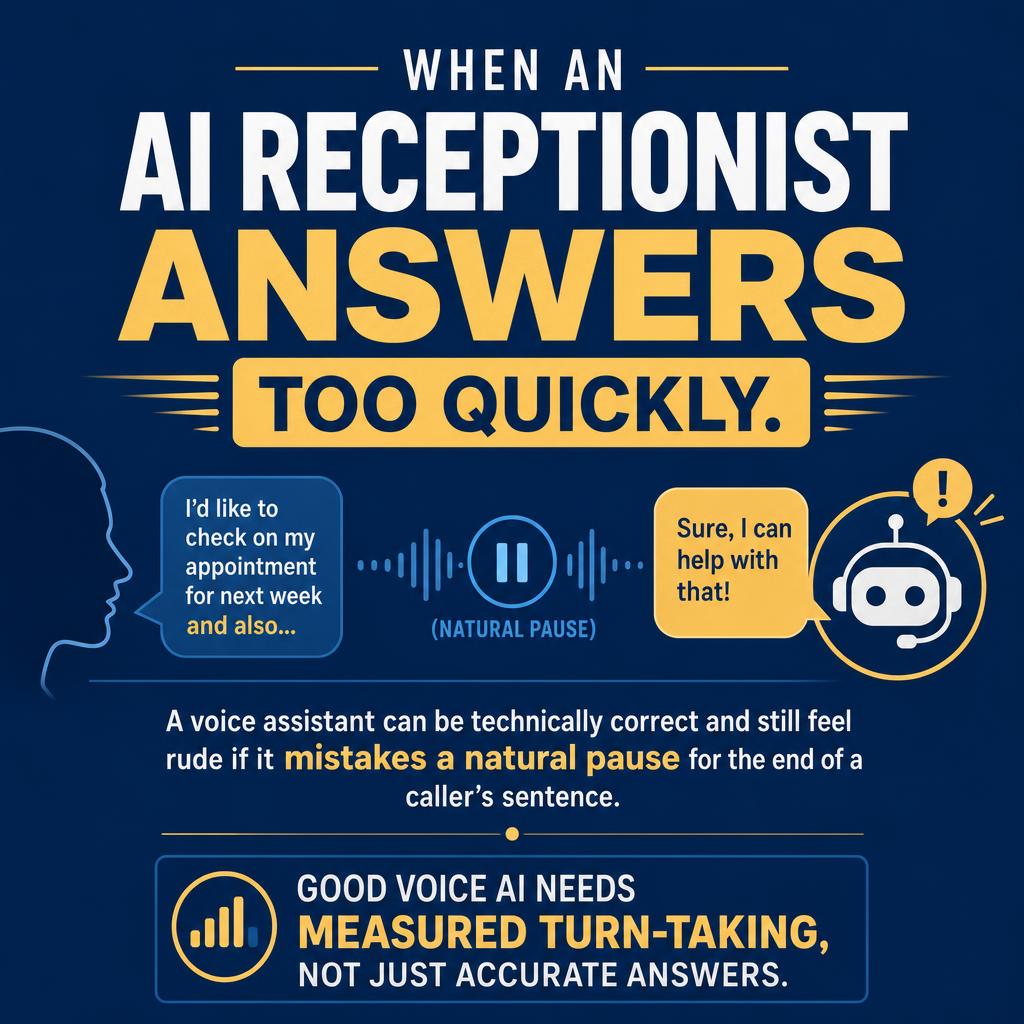
During a recent live call review, the AI receptionist was not waiting long enough after the caller paused. It treated a brief hesitation as the end of the caller's sentence and started speaking too soon.
The assistant was not trying to be rude. It was making a timing decision too aggressively.
For a business owner, that distinction is technically useful, but it does not change the customer experience. The caller still feels rushed. They may repeat themselves, lose confidence, or stop before giving an important detail such as a callback number, address, or reason for the call.
This is why voice AI should not be judged only by whether it answers questions correctly.
It also has to listen naturally.
In a real phone call, silence does not always mean the person is finished. Sometimes the caller is thinking. Sometimes they are checking a detail. Sometimes they are halfway through a sentence and have paused for less than a second.
A human receptionist usually understands that rhythm without thinking about it. A voice assistant has to be configured to make the same kind of judgment.
The useful lesson from this call was not that the assistant was broken. It was that the failure had a specific shape: the system was starting its next response too quickly.
That matters because different call problems need different fixes.
If the assistant gives the wrong answer, you may need to improve instructions, knowledge, or routing. If it fails to stop when the caller speaks, you may need to improve interruption handling. If it waits too long, you may need to reduce dead air. But if it speaks too soon after an ordinary pause, the likely issue is turn-taking patience.
Those problems can sound similar in a customer complaint. The caller might simply say, "The AI was bad" or "It kept talking over me." But the operational fix depends on the evidence.
In this case, the improvement was focused: make the assistant slightly more patient and use smarter end-of-turn detection. In plain English, the system needed a better way to decide whether the caller had genuinely finished speaking or was only pausing to think.
That kind of tuning is safer than changing everything at once.
When a live call feels awkward, the temptation is to rewrite the prompt, change the greeting, adjust the workflow, replace the voice, and alter the escalation rules all in the same pass. That makes the system harder to understand. If the next call improves, you do not know which change helped. If it gets worse, you do not know what caused the regression.
Evidence-led tuning keeps the work smaller and more accountable.
First, identify the failure type. Then change the setting or instruction most closely connected to that failure. Then test another real call and listen for the specific behavior you were trying to improve.
For business owners, this is the practical operating principle: a good AI receptionist should be responsive, but not impatient.
The difference is often measured in fractions of a second. The impact is measured in customer trust.
A caller who feels heard is more likely to finish the conversation, provide the right details, and believe the business is professionally run. A caller who feels interrupted may judge the whole system, and sometimes the whole business, by that one moment.
That is why interruption is not a cosmetic issue.
It is a trust issue.
-----------
If you find this content useful, please share it with this link: [https://patrickmichael.co.za/subscribe](https://patrickmichael.co.za/subscribe)