
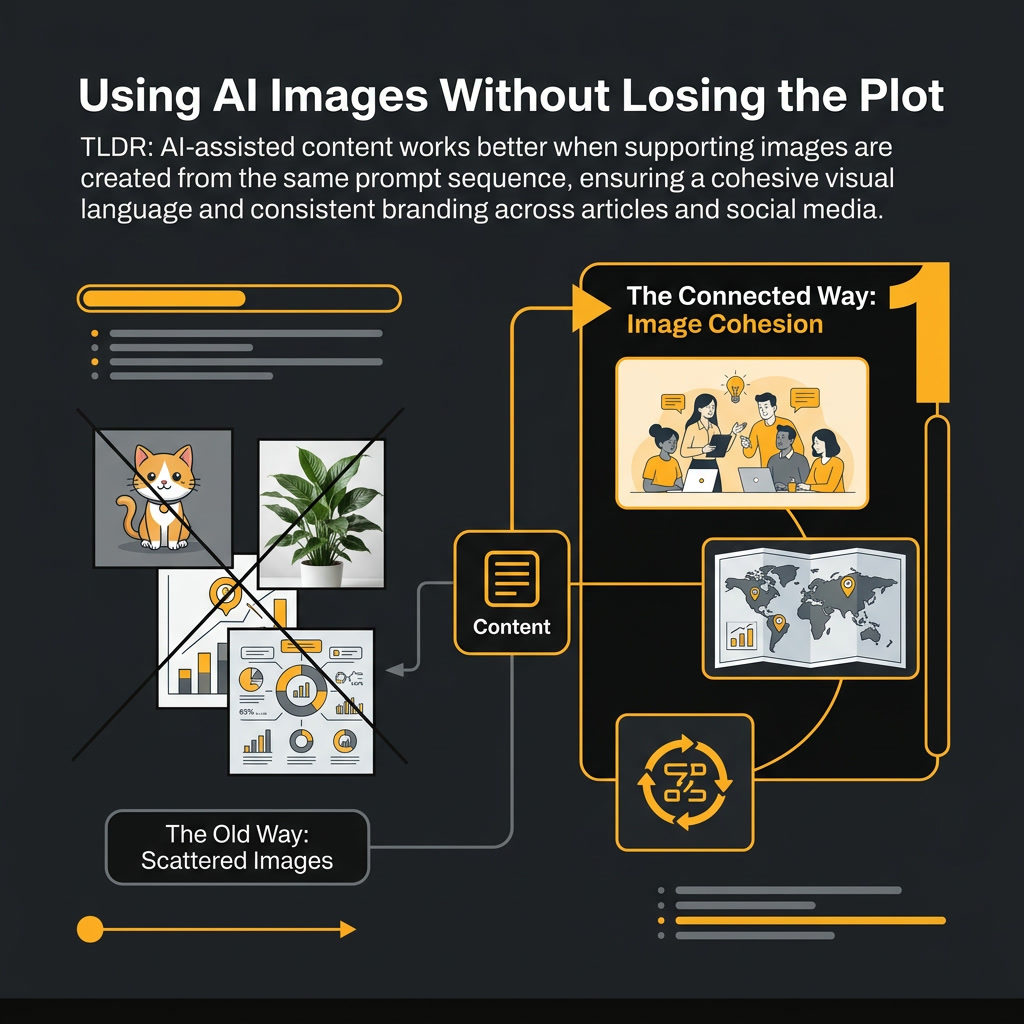
A useful article image should do more than decorate the page.
It should support the idea.
If the article is explaining a business problem, the image should help frame that problem. If the article is teaching a workflow, the image should make the workflow feel concrete. If the article is about a practical lesson from real work, the image should carry some of that context into the reader's first impression.
That is the promise of AI-assisted content creation.
You are not just asking an image tool for something attractive. You are asking it to create a relevant visual companion for a specific article, written for a specific audience, with a specific message.
That changes the job completely.
A generic image prompt can be written once and reused. A context-aware image prompt cannot. It has to be generated from the article, the topic, the intended audience, the publication style, the image purpose, and sometimes the current state of the content workflow.
In our content production application, that is exactly the kind of workflow we have been building.
The article comes first. The image prompt is created in-flow as part of the content process. The system looks at the draft, the article type, the intended visual role, and the saved image metadata for that piece. Then it helps produce a prompt for an article image or hero image.
That is useful because the image starts closer to the meaning of the article.
But it also introduces a business risk.
When the prompt is generated from several sources, it becomes harder to know where each instruction came from.
Some of the prompt may come directly from the article. Some may come from the house style. Some may come from a previous saved image prompt. Some may come from the model making a reasonable interpretation. Some may come from system-level rules that should always apply, such as avoiding internal file names or keeping the image in the correct format.
On the surface, the result may look excellent.
The prompt may be detailed, specific, polished, and visually rich.
But detail is not the same as control.
A long prompt can hide the fact that the content team no longer understands the source of the instruction. That matters when you are trying to build a repeatable content operation, not just produce one acceptable image.
This is where many AI content workflows become fragile.
The business starts with a reasonable goal: make images that better match the article.
Then the system gets more sophisticated. It adds style guidance. It remembers prior work. It uses richer article context. It adds constraints to avoid common image mistakes. It tries to keep the brand feeling consistent.
Each addition makes sense on its own.
But if everything lands in one large prompt box, the operator is left editing the final output instead of managing the actual source of the image direction.
That is the wrong level of control.
For a business user, the question should not be, "Can I rewrite this whole AI prompt by hand?"
The better question is, "Can I see and adjust the intent behind this image?"
That is why the structured brief matters.
Instead of treating the final prompt as the main editable object, the workflow should treat the brief as the source of truth.
The brief can contain fields like subject, composition, environment, style, lighting, colour direction, text requirements, constraints, and additional visual notes.
Those fields are much easier to inspect.
If the image subject is wrong, change the subject. If the style feels too abstract, change the style. If the colour direction is too brand-heavy, edit the colour field. If the constraints are too restrictive, adjust the constraints. If the image needs to feel more like a business article and less like a fantasy poster, say that in the right field.
The final prompt then becomes something the system compiles from the brief.
That sounds technical, but the business idea is simple.
You do not want your team editing a mystery paragraph.
You want them editing the decisions that create the paragraph.
The compiled prompt still matters. It is what gets sent to the image model. But it should be treated as the output of the workflow, not the place where all control lives.
This gives the content process a cleaner operating model.
The article provides the context. The brief captures the image intent. The compiler turns that intent into a final prompt. The image tool generates the visual. The operator reviews the result and either saves, edits, regenerates, or resets.
That sequence is much easier to manage than a single box full of accumulated prompt text.
It also makes the system safer.
A compiler can keep repeated instructions under control. It can make sure the aspect ratio appears once instead of several times. It can remove internal workflow language that should never reach the image model. It can keep palette instructions bounded. It can prevent old prompt fragments from quietly dominating the next image.
That last point is important.
History is useful in content production. You often want the system to remember the latest valid draft or the latest useful visual direction for an article.
But history can also contaminate the next attempt.
If an early prompt included the wrong assumptions, the wrong colour language, or too many constraints, and that prompt becomes the starting point for the next generation, the workflow begins to inherit its own mistakes.
The operator may think they are creating a fresh image for the article.
In reality, they may be working from a prompt that has already been shaped by old context.
That is why a reset path is not just a convenience feature.
It is a control feature.
A reset lets the operator return to a clean starting point. It says: stop trusting the saved prompt history for this image, rebuild from the article and the clean fallback brief, and let me steer the visual direction again.
For a business building AI-assisted content, that is the real lesson.
The goal is not to make the prompt longer.
The goal is to make the process more understandable.
AI can help turn an article into a strong visual direction. It can read the context, suggest useful imagery, and produce a detailed first draft. That is valuable.
But the business should own the structure around that draft.
The business should decide what fields matter. The business should decide which instructions are fixed rules and which are editable suggestions. The business should be able to see the image intent before generation. The business should be able to reset when history becomes unhelpful.
That is how AI-assisted content becomes operational instead of experimental.
You move from asking, "Can the model make us a nice image?" to asking, "Can our workflow reliably produce images that support the article?"
Those are different standards.
A nice image might be enough once.
A useful content system needs repeatability, context, and control.
The final prompt is only one part of that system.
The real asset is the process that produces it.
-----------
If you find this content useful, please share it with this link: [https://patrickmichael.co.za/subscribe](https://patrickmichael.co.za/subscribe)