
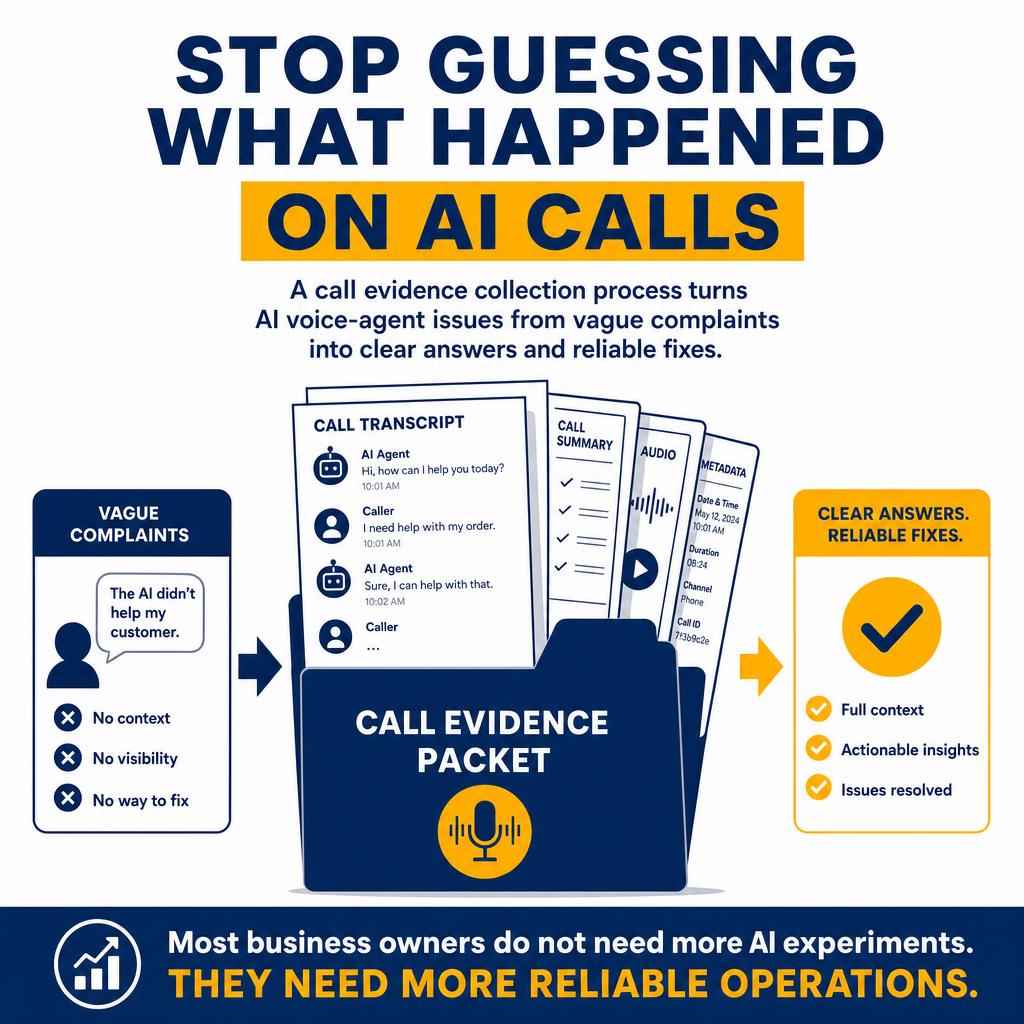
Most business owners do not need more AI experiments.
They need more reliable operations.
That difference matters when a company is using an AI voice agent to answer calls, qualify enquiries, take messages, book appointments, or route customers to the right place.
When something goes wrong in a live call, the tempting response is to jump straight into fixing the assistant.
Change the prompt.
Adjust the instructions.
Tweak the handoff.
Try another test call.
Hope the next one sounds better.
That can feel fast.
But it is often the slow way.
The reason is simple: without evidence, the team is guessing.
A customer says the assistant gave the wrong answer. A staff member says the call did not route properly. Someone notices the assistant asked for information it should already have had. Another person thinks the prompt is the problem. Someone else thinks the integration failed.
All of those may be possible.
But possible is not the same as proven.
This is why a call evidence collection process is so valuable.
In the PM Squad work from this session, we built a repeatable way to take one call ID and turn it into a complete evidence packet. The process collects the actual Vapi call payload, the matching Langfuse trace information, the observations from the call, and a plain-language report that explains what happened.
For a business owner, the important part is not the technical plumbing.
The important part is that the business now has a standard way to answer the question: what actually happened on this call?
That changes the management conversation.
Instead of asking, "Why did the AI do that?" the team can ask better questions:
What did the customer say?
Which assistant handled the call?
Was there a handoff?
What information was available to the assistant at the time?
Did the assistant make an assumption?
Was the issue caused by wording, routing, missing data, or configuration?
What should we retest after the fix?
Those are operational questions.
They lead to better decisions.
One example from the current work was a callback-number issue. The caller was using a web call. In that situation, the system should not assume it has the caller's phone number. The assistant should ask for the best callback number directly.
The evidence showed the opposite. The assistant implied it could use the number the caller was calling from, even though the customer number was not available. The caller then had to correct the assumption.
That is not just a prompt detail.
It is a customer experience issue.
A caller should not have to understand the limitations of the phone system. They should not have to challenge the assistant's assumption. They should feel that the business is asking clear, sensible questions.
Without a structured evidence packet, this kind of issue can easily become vague.
Someone might say, "The assistant handled callback numbers badly." That is true, but not precise enough to fix safely.
The evidence process makes it specific:
This was a web call.
The customer number was not present.
The assistant still behaved as if the current number could be used.
A handoff occurred before the message-taking flow.
The expected retest is clear: on another web call where no customer number is available, the assistant must ask for the best callback number directly.
That level of clarity saves time.
It stops the business from making broad changes when a narrow change is needed. It prevents the team from rewriting large parts of an assistant because one branch of a conversation needs better handling. It also creates a record that future team members can understand without replaying the whole investigation.
There is another benefit: accountability without blame.
When AI systems are discussed casually, problems often sound mysterious. The assistant "got confused" or "did something strange." That language is not very useful.
A good evidence process turns mystery into a sequence.
The caller said this.
The assistant had this data.
The assistant chose this path.
The tool returned this result.
The report classified the outcome this way.
The next retest should prove this specific behavior changed.
That makes improvement calmer.
It also makes it easier for a business owner to decide whether a system is ready for more responsibility.
If every problem requires a developer to dig through logs manually, the voice agent is still fragile as an operation. If every call issue can be turned into a standard evidence packet, the business has a feedback loop.
That feedback loop is where the value is.
AI voice agents improve fastest when the team can move from complaint to evidence to fix to retest. The collection process shortens that loop.
It also protects against accidental damage.
When teams change AI instructions without clear evidence, they often fix one scenario and break another. A well-documented call packet helps prevent that. It shows which scenario was tested, which data was present, what failed, and what must be checked next.
That is especially important as voice systems become more complex.
A single assistant might be manageable by feel. A squad of assistants, each with a different responsibility, needs more discipline. Calls may move from an orchestrator to a knowledge assistant, then to a messaging assistant. Variables may or may not be available after a handoff. Some problems belong in the prompt. Others belong in routing or configuration.
A business owner does not need to know every internal detail.
But they do need confidence that the team is not guessing.
The call evidence collector provides that confidence.
It creates a consistent folder for each test. It saves the raw evidence. It generates a report. It states the observed result. It records the retest requirement.
That turns AI voice improvement into an operating process rather than a series of one-off fixes.
The practical benefit is straightforward:
Faster diagnosis.
Fewer unnecessary changes.
Clearer customer-experience evidence.
Better handoff between technical and non-technical people.
A stronger record of why a change was made.
A clearer test for whether the change worked.
For a business owner, this is the difference between tinkering with an AI assistant and managing a business system.
The assistant is not judged by whether it sounds impressive in a demo.
It is judged by whether the business can see what happened, improve it, and prove the improvement.
That is the real efficiency gain.
Not just faster debugging.
Better operational control.
-----------
If you find this content useful, please share it with this link: [https://patrickmichael.co.za/subscribe](https://patrickmichael.co.za/subscribe)