
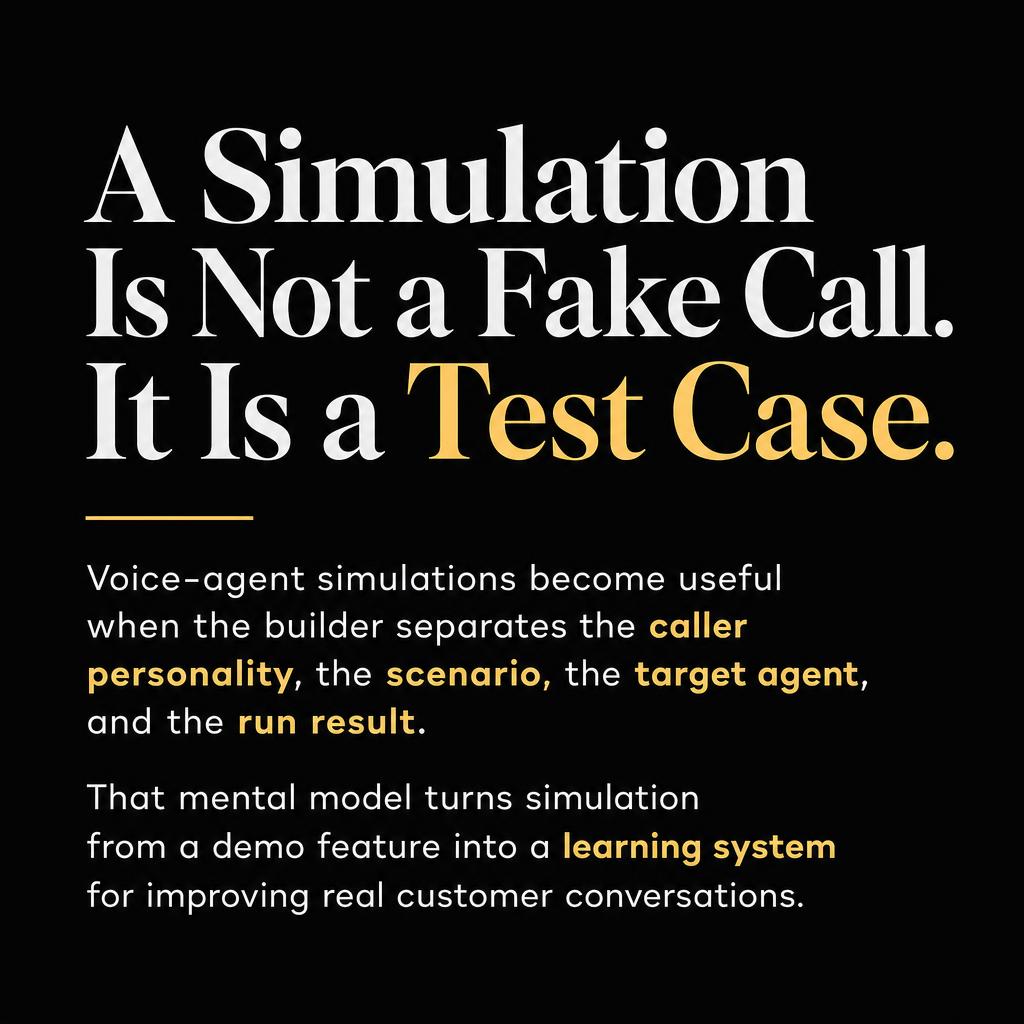
TL;DR: A voice-agent simulation is not just a fake call. It is a reusable test case made from a caller personality and a scenario. The run is what happens when that test case is executed against a specific assistant or squad. If your builder cannot explain those parts clearly, the test is probably producing confidence theatre instead of useful feedback.
When people first see voice-agent simulations, the easy assumption is that they are just fake calls.
You press a button. A simulated customer speaks to the agent. The agent responds. You look at the result.
That is useful, but it is not the main value.
The main value is the mental model behind the test.
A simulation is not simply a conversation that happened. It is a reusable test case. In Vapi terms, the model becomes clearer when you separate the pieces:
Personality plus scenario equals simulation.
Simulation or suite plus target equals run.
The personality is the simulated caller.
Are they cooperative, confused, impatient, vague, direct, or asking from the wrong starting point?
The scenario is the situation that caller is in, plus the criteria used to judge the outcome.
Are they asking a knowledge question? Trying to make a booking? Leaving a message? Asking something the agent should refuse? The scenario defines what success means.
The simulation combines those two things: this kind of caller, in this kind of situation.
The target is separate.
That target might be one assistant, or it might be a full squad of assistants. The run is what happens when the simulation is executed against that target.
This distinction matters.
If a builder says, "we ran a simulation and it passed," the next question should not be, "what score did it get?"
The better question is: what exactly did you simulate?
Was the caller realistic?
Was the scenario tied to a real business outcome?
Were the evaluation criteria specific enough to catch a bad answer?
Was the test run against the same assistant or squad that customers actually reach?
Without that clarity, simulations can become theatre. They produce green ticks, but they do not teach you very much.
With the right model, simulations become a feedback system.
You can test whether a voice agent handles a cooperative customer before testing an impatient one. You can separate a knowledge failure from a routing failure. You can reuse the same scenario against different versions of an assistant and see whether the behaviour improves.
You can also group simulations into a suite, then use that suite to check whether important paths still work after a change.
That is why we started a learning library inside the pm_voice_agents project.
The goal is not only to document commands. A user manual can show someone how to run the tool. Learning material should help them understand what the tool is for.
For a business owner choosing a voice-agent builder, this becomes a useful competence signal.
A capable builder should not only say, "we test our agents."
They should be able to explain the test design in plain language:
Who is the simulated caller?
What situation are they in?
What does success mean?
Which assistant or squad is being tested?
What did the run teach us?
That is the difference between checking that an agent responds and learning whether it is ready for real customer conversations.
The operating principle is simple: better mental models create better simulations. Better simulations create better feedback. Better feedback gives you a more accountable way to improve the voice agent.
-----------
If you find this content useful, please share it with this link: [https://patrickmichael.co.za/subscribe](https://patrickmichael.co.za/subscribe)