
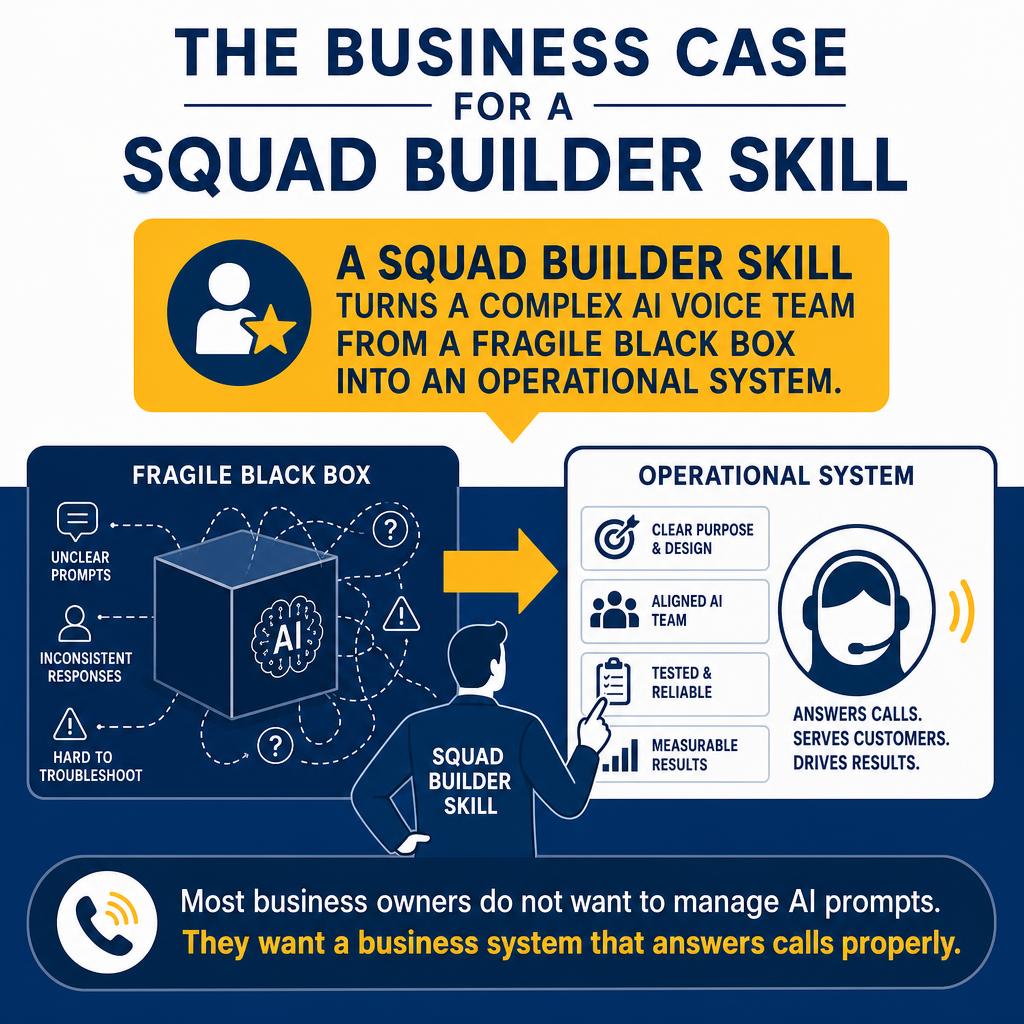
TL;DR: A squad builder skill helps a business manage multiple AI voice assistants through evidence instead of guesswork. It separates direct assistant failures from handoff failures, keeps fixes narrow, prevents unsupported live changes, and gives the business a repeatable way to audit, improve, and retest its AI call system.
Most business owners do not want to manage AI prompts.
They want a business system that answers calls properly, routes customers correctly, captures the right details, and improves without creating new problems.
That is where a squad builder skill becomes valuable.
A single AI voice assistant is already difficult to manage by feel. A squad of assistants is more powerful, but it also introduces more places where things can go wrong.
One assistant might greet the caller and decide what they need. Another might answer detailed company questions. Another might take a message. Another might handle bookings. In a well-designed voice operation, each assistant has a clear job.
But the business owner still needs to know one thing:
When something goes wrong, can we tell why?
Without a structured way to inspect the squad, the answer is often no.
The symptom might be simple. A caller says, "The assistant asked me for the wrong thing." Or, "It did not pass me to the right place." Or, "It asked for information I had already given." Those are useful complaints, but they are not enough to fix the system safely.
The real question is what caused the behavior.
Was the prompt unclear?
Was the wrong assistant handling the call?
Was the handoff between assistants badly described?
Was important caller information missing?
Was the live configuration different from the local file?
Was the report itself overstating what happened?
Those are very different causes.
They require very different fixes.
A squad builder skill gives the business a disciplined way to answer those questions.
It does not start by rewriting the assistant. It starts by gathering evidence.
That matters because AI voice systems can sound convincing even when the internal diagnosis is wrong. A team can easily hear one bad call and decide, "We need to change the prompt." Sometimes that is true. But sometimes the issue is routing. Sometimes it is missing data. Sometimes the assistant did the right thing for the information it had. Sometimes the test report label is misleading.
In this session, that distinction became very practical.
We were reviewing the Patrick Michael PM Squad, a multi-assistant voice setup with specialist responsibilities. The task was not just to improve a prompt. The task was to mature the skill used to inspect the squad itself.
One evidence packet involved a direct Messaging assistant web call where the assistant asked for an email address during message capture. The expected behavior was different: capture the message and callback details without asking for email. That evidence supported a prompt-owned fix target for the Messaging assistant.
But the same packet did not prove a handoff problem.
That distinction is important for a business owner.
If the team wrongly treats a direct assistant failure as a squad handoff failure, they may change the routing setup and create new problems. If they correctly classify it as a direct Messaging behavior failure, the fix stays narrow. The business gets a cleaner improvement with less risk.
That is the core business benefit of the squad builder skill: it stops the team from applying broad fixes to narrow problems.
The skill forces every issue into a useful operating question:
What evidence do we have?
What evidence is missing?
What category does this failure belong to?
What should we inspect before changing anything?
What exact file, prompt section, or configuration block would be touched if the evidence supports it?
What command validates the change locally?
What live update command would apply it later, if the business chooses to proceed?
What retest proves the fix worked?
What stop condition prevents a speculative change?
For a non-technical business owner, the value is not in the file names or command names.
The value is in the control system.
The squad builder skill creates a way to manage AI voice operations with the same seriousness a business would apply to sales process, customer service scripts, booking workflows, or quality assurance.
It gives the business a repeatable method for improving the system.
There are several practical benefits.
First, it reduces guesswork.
When a caller has a bad experience, the natural reaction is to ask the AI builder to fix it. But a good AI builder should first ask, "What exactly happened?" The squad builder skill makes that the default. It uses raw call evidence, assistant snapshots, rendered payloads, live squad artifacts, and generated reports as a structured packet.
That means the business is not relying on memory, screenshots, or impressions.
It is working from the actual behavior of the system.
Second, it protects the customer experience.
AI voice systems are customer-facing. A small error can feel awkward to the caller. If the assistant asks for an email when the business only wanted a message and callback number, the customer may become confused. If the assistant assumes a phone number is available when it is not, the caller may have to correct it. If the call is routed to the wrong specialist, the conversation feels less professional.
The squad builder skill helps catch those issues as specific operating failures, not vague complaints.
Third, it prevents unnecessary rework.
A multi-agent squad has several layers: prompts, handoffs, variables, tools, local configuration, live configuration, and test evidence. Without a structured audit, a team might spend hours editing the wrong layer. The skill makes the team prove which layer is implicated before recommending a fix.
That saves money.
It also keeps the system more stable.
Fourth, it creates accountability without blame.
When something goes wrong in an AI call, it is easy to say, "The AI got confused." That is not useful. A better operating statement is: "This direct Messaging web-call behavior failed. The assistant asked for an email during message capture. There was no handoff evidence in this packet. The fix target is prompt-owned, and handoff causes remain unproven."
That kind of language changes the conversation.
It turns a fuzzy failure into a manageable improvement task.
Fifth, it gives business owners a safer path to scale.
A business can often get a demo assistant working. Scaling that assistant into a reliable phone operation is different. The moment there are multiple specialists, handoffs, customer data, callbacks, bookings, and live updates, the business needs governance.
The squad builder skill is part of that governance.
It documents what the squad is meant to do. It compares local intent with live reality. It checks whether each assistant is staying in its lane. It distinguishes fact-backed findings from hypotheses. It refuses to treat incomplete evidence as permission to change production behavior.
That last point matters.
The skill can recommend commands and stop conditions when evidence supports an edit. But it does not treat evidence gathering as the same thing as live implementation. Live changes remain a deliberate business decision.
That is a mature operating boundary.
It means the business can move faster without becoming reckless.
The completed Phase 6 work added operator examples so the skill can be used again. One example shows how to ask for a customer-number failure diagnosis. One shows how to ask the specialist sub-agent to audit the full squad. One uses the do-not-ask-for-email evaluation for a specific direct Messaging call.
That example is deliberately narrow: it asks only whether direct Messaging asked for an email during message capture, and it explicitly says not to treat the call as handoff evidence.
That is exactly the mindset business AI systems need.
Use evidence.
Classify carefully.
Fix narrowly.
Retest clearly.
Avoid live changes until the cause is proven and the business chooses implementation.
The broader lesson is simple.
AI voice assistants are not just prompts. They are business processes that speak.
If a business is going to rely on them, it needs more than clever wording. It needs a way to inspect behavior, assign cause, and improve safely.
A squad builder skill provides that layer.
It turns a multi-agent voice setup from something that only a technical person can reason about into an operating system a business owner can manage through evidence.
That is the real capacity of the skill.
Not just building assistants.
Building confidence that the assistant team can be audited, improved, and trusted.
-----------
If you find this content useful, please share it with this link: [https://patrickmichael.co.za/subscribe](https://patrickmichael.co.za/subscribe)